Top Belt Annealing Furnace Manufacturers for Global Buyers
Choosing a Belt Annealing Furnace is a production decision, not a simple equipment purchase. Global buyers must examine heating uniformity, belt stability, atmosphere control, cooling performance, and service support. A polished brochure cannot reveal every operating weakness.
Dr. George E. Totten, a respected authority in heat treatment, states, “Heat treatment is the controlled heating and cooling of a material to achieve desired properties.” This principle guides our review. A reliable Belt Annealing Furnace should maintain consistent temperatures across the working zone. It should also protect delicate strip, wire, or small components from oxidation and distortion. Practical details matter. Belt alignment, furnace sealing, thermocouple placement, and replacement-part access can affect daily output.
This guide compares leading manufacturers for international buyers. It considers engineering experience, factory capability, quality systems, customization, installation support, and long-term operating value. We also examine real-world questions. Can the supplier support different belt materials? Can technicians respond across time zones? Are performance claims supported by test records? These questions often separate dependable partners from attractive sellers.
No ranking is flawless. Buyer priorities differ. A compact furnace may suit a research line, while a continuous producer needs stronger throughput and automation. Energy consumption may look acceptable on paper, yet poor insulation can increase monthly costs. That deserves closer attention. The following overview offers a practical starting point, while encouraging buyers to verify specifications, references, and acceptance-test conditions before signing a contract.
Belt Annealing Furnaces: Definition, Types, and Industrial Applications
Top Belt Annealing Furnace Manufacturers for Global Buyers
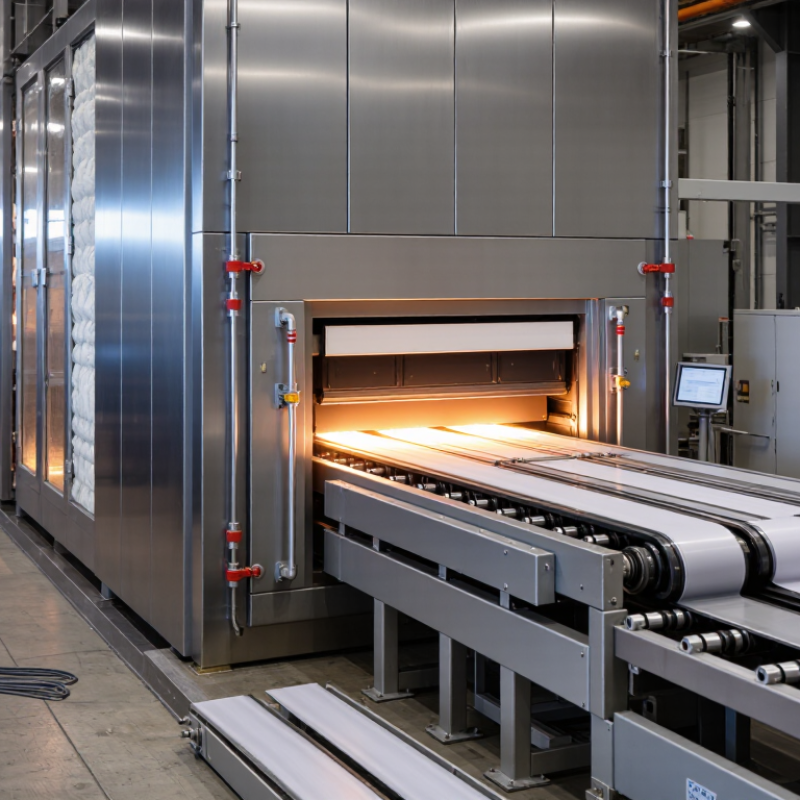
A belt annealing furnace is a continuous thermal system. It moves metal parts through controlled heating, soaking, cooling, and discharge zones. Unlike batch furnaces, it supports steady production with repeatable temperature profiles.
Common types include mesh-belt, roller-hearth, and pusher-belt designs. Mesh belts suit small fasteners, stamped parts, and precision components. Roller systems handle heavier loads and flatter products. Pusher designs can support dense charges, but they often require stricter alignment control. Atmosphere selection also matters. Nitrogen, hydrogen, or blended gases can reduce oxidation and improve surface quality when properly monitored.
The World Steel Association reported 1.892 billion tonnes of crude steel production in 2023. That scale explains continued demand for reliable heat-treatment equipment. The International Energy Agency identifies industry as responsible for about 37% of global final energy use. Furnace efficiency therefore affects both operating cost and emissions exposure. Buyers should compare temperature uniformity, belt life, gas recovery, controls, and maintenance access. A lower purchase price may hide costly downtime. The boundary between “high efficiency” and ordinary performance is sometimes unclear. Independent energy measurements are still necessary. Manufacturers should provide test records, calibration procedures, and application references, not only attractive specifications.
Key Criteria for Evaluating Global Furnace Manufacturers
Top Belt Annealing Furnace Manufacturers for Global Buyers
Key Criteria for Evaluating Global Furnace Manufacturers
Choosing a belt annealing furnace starts with process evidence, not attractive brochures. Ask whether the manufacturer has handled your alloy, strip thickness, and production speed. Request temperature uniformity maps from comparable furnaces. A reliable system should show stable heating across the working width. It should also control atmosphere purity, dew point, and belt tension during continuous operation. Small details matter.
Review the engineering package carefully. It should include thermal calculations, airflow designs, control logic, and maintenance access. Ask how the furnace performs during start-up, power interruptions, and product changes. Factory acceptance testing can reveal unstable zones or slow response times. However, test conditions may be easier than real production. That deserves attention.
Manufacturer reliability also depends on people and support. Check technician experience, training procedures, spare-part availability, and response times across your region. Examine references from plants with similar output and operating hours. Energy consumption should be measured under defined loads, not estimated loosely. Safety documentation and conformity records must match the destination market. A polished factory tour proves little. One uncomfortable question can reveal more: what commonly fails after commissioning? Total ownership cost, including belt replacement and calibration, should guide the decision.
Leading Belt Annealing Furnace Manufacturers by Regional Market
Top Belt Annealing Furnace Manufacturers for Global Buyers
Leading Belt Annealing Furnace Manufacturers by Regional Market
Regional demand strongly influences belt annealing furnace design. East Asian manufacturers often emphasize compact layouts, fast production cycles, and competitive automation. Their systems may suit high-volume lines producing stainless steel strips, small components, or precision wire parts. Buyers should inspect belt tension control, furnace uniformity, and real energy readings rather than relying on catalog figures.
European manufacturers commonly focus on thermal efficiency, traceable process control, and flexible atmosphere management. Their equipment often includes detailed temperature mapping, programmable recipes, and recovery systems for reduced heat loss. North American suppliers frequently highlight robust maintenance access, safety interlocks, and integration with existing factory controls. These features matter when operators need quick belt replacement or remote diagnostics.
Manufacturers in India and Southeast Asia often provide practical customization for local plant conditions, including voltage requirements, limited floor space, and varied material inputs. Some offer strong installation support, but service quality can differ between regions. Request commissioning records, spare-parts lead times, and references from comparable production lines.
I have seen buyers compare only furnace prices and overlook exhaust design or cooling stability. That mistake becomes expensive later.
No shortlist is perfect. A factory audit, sample run, and independent acceptance test can reveal weaknesses before shipment. Temperature uniformity should be checked across the working width, not only at the center.
Technology, Customization, and Service Capabilities Compared
Top Belt Annealing Furnace Manufacturers for Global Buyers
Technology, Customization, and Service Capabilities Compared
Global buyers comparing belt annealing furnace manufacturers should examine more than heating temperature and catalog capacity. Production experience appears in practical details, including stable belt tracking, even zone control, and clean handling of thin strip. A well-designed line may use multiple heating zones, calibrated thermocouples, protective gas monitoring, and automatic tension control. These features reduce oxidation, warping, and uneven hardness during continuous processing. Specifications alone are not enough.
Customization separates a standard supplier from a capable engineering partner. Ask whether the furnace can match your alloy, belt width, line speed, loading method, and plant utilities. Reliable suppliers provide thermal calculations, trial data, layout drawings, and documented acceptance criteria before fabrication. They should also explain limits, such as maximum coil weight or slower speeds for sensitive materials. That honesty matters. However, customization can become expensive when every change is treated as exceptional. A clear interface list prevents late redesigns.
Service capability deserves equal attention after installation. Compare commissioning support, operator training, spare-part availability, remote diagnostics, and regional response times. Reliable documentation should include wiring diagrams, maintenance intervals, alarm logic, and calibration records. Experienced teams can identify a drifting temperature zone before it damages a full production batch. Still, no supplier is perfect. Some promises sound strong until production exposes weak software integration or delayed field support. Request references from similar applications and inspect evidence, not polished claims.
| Evaluation Dimension | Standard Production Supplier | Advanced Controlled-Atmosphere Supplier | Custom Turnkey Line Integrator |
|---|---|---|---|
| Typical Furnace Configuration | Continuous mesh-belt or solid-belt furnace with preheating, heating, cooling, and discharge sections. | Multi-zone continuous furnace with sealed chambers, atmosphere control, rapid cooling, and integrated dew-point monitoring. | Engineered production line combining loading, cleaning, annealing, cooling, inspection, unloading, and plant-level controls. |
| Common Operating Temperature | Approximately 600–950 °C, depending on alloy, component geometry, and annealing cycle. | Approximately 850–1,200 °C for high-temperature ferrous, stainless-steel, copper, and nickel-alloy applications. | Approximately 600–1,250 °C, with the usable range defined by the selected heating elements, insulation, atmosphere, and process recipe. |
| Atmosphere Options | AirNitrogenLow-oxygen air | NitrogenNitrogen-hydrogenEndothermic gasDew-point control | Multi-gas recipesOxygen monitoringHydrogen safety systemRecipe-based control |
| Usual Effective Belt Width | About 100–600 mm for general-purpose component production. | About 300–1,200 mm for higher-throughput or atmosphere-sensitive production. | Approximately 200–1,500 mm, subject to product size, loading pattern, thermal uniformity, and factory layout. |
| Typical Throughput Approach | Batch size and belt speed are selected for small-to-medium production volumes and relatively stable product families. | Throughput is calculated from belt width, product loading density, belt speed, residence time, and required heating or cooling rate. | Line capacity is matched to takt time, upstream forming or machining, downstream inspection, and planned annual output. |
| Temperature-Zone Arrangement | Commonly 3–8 independently controlled zones, including preheat, soak, and cooling sections. | Often 6–15 or more controlled zones, allowing tighter ramp, soak, atmosphere, and cooling management. | Zone count is custom-designed using thermal modeling, product trials, heat-balance calculations, and required production takt time. |
| Temperature Uniformity Target | Typically around ±5–10 °C after stabilization, depending on furnace size and process requirements. | Typically around ±3–5 °C in the working zone when properly loaded and commissioned. | Project-specific acceptance criteria, commonly verified through temperature uniformity surveys and production-load testing. |
| Heating Technology | Electric resistance heating with ceramic, metallic, or silicon-carbide heating elements selected for the operating range. | Multi-zone electric resistance heating with high-temperature elements, independent power control, and thermal insulation optimized for atmosphere service. | Heating, cooling, exhaust, and energy systems are selected through a complete thermal and utility assessment. |
| Cooling Capability | Natural or forced-air cooling for components that do not require an accelerated or atmosphere-protected quench. | Controlled forced-air or indirect gas cooling, commonly with closed-loop temperature monitoring. | Custom cooling tunnels, gas cooling, water-jacket systems, or staged cooling may be integrated according to metallurgy and cycle-time requirements. |
| Belt Materials | Heat-resistant stainless-steel mesh, balanced-weave mesh, or solid belt selected for load, temperature, and product geometry. | High-temperature stainless-steel or nickel-alloy belt options for demanding temperature, atmosphere, and service-life conditions. | Belt construction is selected after reviewing product weight, contact marks, abrasion, distortion risk, atmosphere, and maintenance strategy. |
| Process Control | PLC-based control with touchscreen HMI, temperature recording, alarms, and basic recipe storage. | PLC/SCADA control with recipe management, atmosphere feedback, data logging, password levels, and remote diagnostic capability. | Factory-wide integration may include MES connectivity, barcode or RFID tracking, OEE reporting, historian systems, and automated quality release. |
| Atmosphere and Safety Features | Basic exhaust, gas-flow control, over-temperature protection, door or access interlocks, and emergency shutdown. | Gas leak detection, purge sequences, oxygen monitoring, hydrogen-safe ignition and shutdown logic, pressure control, and interlocked access protection. | Full safety review covering gas storage, ventilation, combustion or electrical systems, hazardous-area requirements, emergency response, and operator access. |
| Customization Scope | Belt width, furnace length, heating zones, loading height, atmosphere option, and discharge arrangement. | Thermal profile, gas mixing, dew-point control, cooling rate, belt material, data acquisition, and product-specific fixtures. | Complete line layout, robotics, washing, pre-treatment, quenching, inspection, traceability, material handling, and plant utilities. |
| Best-Fit Applications | General steel parts, fasteners, stamped components, small hardware, copper parts, and repetitive production with moderate atmosphere sensitivity. | Stainless-steel parts, precision components, wire products, electronic or electrical materials, copper alloys, and applications requiring controlled surface condition. | Automotive, aerospace, energy, appliance, and high-volume industrial programs requiring validated recipes, traceability, and integrated automation. |
| Validation and Documentation | Operating manuals, electrical drawings, spare-parts lists, calibration records, and basic factory acceptance testing. | Includes process recipes, instrument calibration, atmosphere records, temperature uniformity testing, factory acceptance testing, and commissioning reports. | May include complete design qualification, installation qualification, operational qualification, performance qualification, risk assessments, and digital documentation packages. |
| Relevant Technical Frameworks | Requirements are commonly aligned with applicable machinery, electrical, pressure, and workplace-safety regulations in the destination market. | May additionally require heat-treatment control practices such as AMS2750-style temperature measurement and uniformity methods where contractually specified. | Project compliance is defined by the buyer’s industry, destination-country regulations, customer specifications, and required certification scheme. |
| Service Model | Remote troubleshooting, commissioning support, operator training, planned maintenance guidance, and replacement parts. | Application engineering, process trials, atmosphere tuning, preventive maintenance programs, calibration support, and remote diagnostics. | Project management, installation supervision, production ramp-up, operator certification, spare-parts planning, lifecycle upgrades, and service-level agreements. |
| Most Important Buyer Checks | Actual temperature profile, belt life, energy consumption, spare-parts availability, and suitability for the intended product mix. | Atmosphere stability, dew point, oxygen level, uniformity under production load, cooling performance, safety system design, and data integrity. | Reference-cycle results, guaranteed throughput, integration responsibility, acceptance criteria, utility consumption, cybersecurity, training, and long-term support. |
A Step-by-Step Guide to Selecting the Right Manufacturer
Selecting a belt annealing furnace manufacturer requires more than comparing purchase prices. Start by defining material, strip width, target hardness, line speed, and atmosphere. Record these values from actual production data. A furnace designed for thin steel may fail with copper alloys or uneven loading. Measure temperature uniformity across the working zone, not only the controller display.
Energy performance deserves close attention. The U.S. Department of Energy’s Industrial Decarbonization Roadmap reports that process heating represents about 51% of industrial energy use. Ask manufacturers for thermal-efficiency figures, heat-loss calculations, and annual energy estimates. Request test results at your operating load. Empty-furnace figures can look impressive but mislead. Sometimes, the “efficient” option is only efficient on paper.
Examine engineering depth and service reliability. Confirm whether the manufacturer can provide atmosphere control, belt tracking, cooling design, spare-parts planning, and remote diagnostics. Require a factory acceptance test using representative parts, with agreed limits for temperature deviation and throughput. Review installations with similar materials and duty cycles. Industry 4.0 reports from the International Federation of Robotics show continued growth in industrial automation, yet connectivity alone does not guarantee stable annealing. Check alarm history, maintenance access, and operator training. I would also challenge every promised production rate. A cautious supplier that explains limitations may be more dependable than one offering perfect numbers.
Article Source:
Have Questions? We're Here to Help!
Give us a call at (864) 989-0566 or send us a message to discuss our testing equipment with an expert.