What Are the Top Air Conditioner Parts for Buyers?
When buyers search for the top Air Conditioner Parts, they often begin with price. That approach can be misleading. A low-cost capacitor may fail quickly, while a correctly rated contactor can protect the compressor and reduce service interruptions.
The U.S. Department of Energy reports that heating and cooling represent about 48% of household energy use. The International Energy Agency also states that space-cooling demand has more than tripled since 1990. These findings make component quality an operating issue, not merely a repair concern. Filters, capacitors, fan motors, thermostats, contactors, compressors, and control boards can influence airflow, electrical safety, comfort, and energy consumption.
“Cooling is essential for human health and productivity,” says Dr. Fatih Birol, Executive Director of the International Energy Agency. His observation supports a practical buying question: which component keeps the whole system dependable?
There is no universal winner.
The best Air Conditioner Parts depend on system type, voltage, refrigerant design, climate, and maintenance history. A homeowner in humid Florida may prioritize corrosion-resistant coils and reliable drain components. A warehouse manager may value heavy-duty motors and easy replacement access. Buyers should verify model compatibility, manufacturer specifications, certification, warranty coverage, and installer recommendations.
Industry shipment data from the Air-Conditioning, Heating, and Refrigeration Institute shows continuing demand for residential and commercial HVAC equipment. That demand also increases the need for traceable replacement parts. Still, product descriptions can hide important differences. “Universal” does not always mean suitable. A part may fit physically yet perform poorly electrically.
This guide examines the parts buyers should consider, while acknowledging an uncomfortable truth: the cheapest purchase may become the most expensive decision.
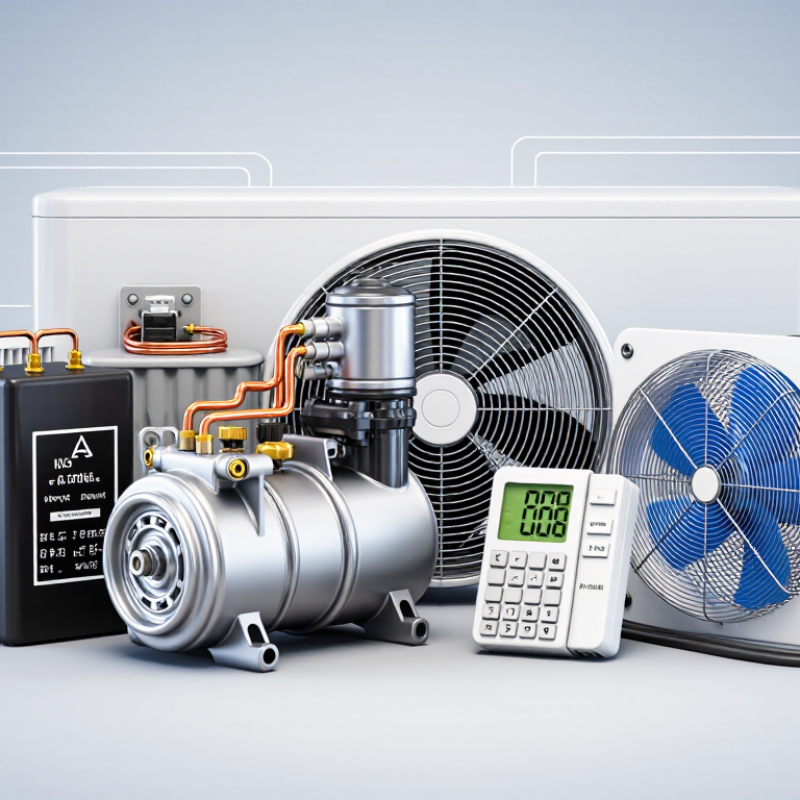
Understanding the Main Air Conditioner Parts and Their Functions
What Are the Top Air Conditioner Parts for Buyers?
Understanding each air conditioner part makes purchasing and maintenance decisions more reliable. The compressor moves refrigerant through the sealed system and sets the cooling cycle in motion. The condenser coil releases indoor heat outdoors, while its fan pushes air across warm metal fins. The expansion device reduces refrigerant pressure before it reaches the evaporator coil. Inside the room, the evaporator absorbs heat from passing air. The blower then returns cooled air through the duct or grille. Small part, large effect.
The thermostat measures room temperature and signals when cooling should begin. A filter protects the evaporator from dust, although it cannot replace professional cleaning. In service inspections, a blocked filter often reduces airflow and increases coil icing risk. The drain pan collects condensation, while the drain line carries water away. That matters in humid rooms. The International Energy Agency’s The Future of Cooling report projects that global space-cooling energy demand could more than triple by 2050 without stronger efficiency improvements. The U.S. Department of Energy also identifies proper sizing, airflow, and equipment efficiency as key performance factors. Buyers should check coil condition, compressor compatibility, fan noise, filter access, and replacement-part availability. No checklist is perfect. A high-efficiency unit can still perform poorly when installation is careless or airflow is restricted. Personally, I would inspect the drain route and electrical connections before judging cooling performance. They are easy to overlook.
Choosing the Right Compressor, Condenser, and Evaporator
Choosing the right air conditioner parts starts with matching the compressor, condenser, and evaporator as one system. The compressor drives refrigerant through the circuit and controls cooling capacity. An incorrectly sized compressor may cycle too often, waste electricity, or struggle during a hot afternoon. The IEA’s The Future of Cooling report projects that global space-cooling demand could more than triple by 2050. Efficiency matters.
The condenser releases indoor heat outdoors. Look for adequate coil surface, durable tubing, and clear airflow around the outdoor unit. In a practical inspection, dust often appears between the fins, while blocked airflow raises discharge pressure. That small detail can shorten compressor life. The evaporator absorbs heat indoors, so its coil design should support even airflow and stable dehumidification. A cold coil is not automatically an efficient coil.
Compatibility is easy to underestimate. Check refrigerant type, voltage, operating range, fan capacity, and control signals before purchasing separate parts. The U.S. Department of Energy links proper equipment sizing and installation with better comfort and lower energy use. UNEP’s 2023 Cooling Stocktake also identifies rising cooling demand as a major energy and emissions challenge. I would not choose only by the lowest price. A cheaper condenser may have thinner fins, weaker corrosion resistance, or limited service access. Still, data sheets can be imperfect; field conditions may expose gaps that laboratory ratings miss.
Comparing Air Filters, Blower Motors, and Expansion Devices
What Are the Top Air Conditioner Parts for Buyers?
Comparing Air Filters, Blower Motors, and Expansion Devices
Air filters, blower motors, and expansion devices influence comfort, energy use, and repair costs. The best choice depends on system design, climate, and maintenance habits. The International Energy Agency reports that cooling demand has tripled since 1990. That trend makes efficient components increasingly important.
Air filters protect indoor air quality and the evaporator coil. A higher-rated filter may capture smaller particles, but it can also restrict airflow. The U.S. Department of Energy notes that heating and cooling represent about 48% of household energy use. Therefore, buyers should check airflow requirements, not only filtration ratings. A dirty filter often feels like weak equipment.
Blower motors move conditioned air through ducts and rooms. Variable-speed motors can adjust airflow more precisely than fixed-speed designs. They may improve humidity control and reduce operating noise. Expansion devices regulate refrigerant entering the evaporator. A thermostatic or electronic device can respond to changing load conditions. However, incorrect sizing can cause poor cooling, frost, or compressor stress. Field experience shows that installation quality often matters as much as the component itself.
Tips: Match the filter to the manufacturer’s airflow limits. Ask for measured temperature and pressure readings. Replace damaged blower capacitors promptly. Have a qualified technician verify superheat and subcooling after expansion-device work. The U.S. Department of Energy emphasizes proper maintenance, yet real homes rarely maintain perfect duct sealing. That limitation deserves honest consideration.
What Are the Top Air Conditioner Parts for Buyers? - Comparing Air Filters, Blower Motors, and Expansion Devices
| Comparison Dimension | Air Filters | Blower Motors | Expansion Devices |
|---|---|---|---|
| Primary function | Captures airborne dust and particles before air passes through the indoor coil and air handler. | Drives the indoor fan to circulate conditioned air through the ductwork or indoor unit. | Controls and meters refrigerant flow into the evaporator, helping regulate cooling performance and superheat. |
| Typical examples | Flat-panel, pleated, washable, and high-efficiency filters. | PSC motors and electronically commutated motors (ECM). | Thermostatic expansion valves (TXVs) and fixed orifice devices. |
| Common materials | Synthetic fiber, fiberglass, cotton, or pleated media in a cardboard or plastic frame. | Copper windings, steel housing, aluminum or steel rotor components, bearings, and electrical insulation. | Brass, stainless steel, copper, or corrosion-resistant alloy components with a sensing orifice and valve assembly. |
| Typical service interval | Inspect monthly. Replace approximately every 1–3 months for many standard systems, depending on dust, pets, occupancy, and filter type. | Inspect during scheduled HVAC maintenance. Service life commonly ranges from about 10–20 years when properly matched and maintained. | No routine replacement schedule. Inspect when refrigerant flow, superheat, or cooling symptoms indicate a possible fault. |
| Typical pressure drop or operating range | A clean filter often has a low pressure drop; many residential filters are commonly rated around 0.1–0.3 in. w.g. at their rated airflow. | Residential airflow is often designed around approximately 350–450 CFM per ton of cooling, subject to system design. | The device must be selected for the refrigerant, system capacity, evaporating conditions, and required superheat control. |
| Key buyer specifications | Length, width, thickness, airflow rating, filtration efficiency, frame type, and pressure drop. | Voltage, phase, frequency, horsepower, RPM, rotation, frame size, shaft dimensions, mounting pattern, and control method. | Refrigerant type, capacity, inlet and outlet connections, flow direction, superheat range, and compatibility with the evaporator and condenser. |
| Typical failure symptoms | Reduced airflow, higher operating costs, dust buildup, coil contamination, or increased system strain. | No indoor airflow, intermittent starting, unusual humming, overheating, abnormal noise, or incorrect fan speed. | Low cooling capacity, coil icing, unstable superheat, restricted refrigerant flow, or abnormal suction pressure. |
| Installation difficulty | Low. Most correctly sized filters can be replaced without specialized tools. | Moderate to high. Electrical isolation, wiring, rotation, mounting, and airflow testing are required. | High. Refrigerant recovery, evacuation, leak testing, and system charging may be required. |
| Maintenance needs | Regular visual inspection and timely replacement. Avoid using a filter that is too restrictive for the air handler. | Keep the motor and fan assembly clean, check bearings and electrical connections, and verify proper airflow. | Maintain clean refrigerant circuits, replace restricted filter-driers when appropriate, and verify system charge and operating pressures. |
| Relative purchase cost | Low; commonly purchased as a recurring consumable. | Medium to high; cost varies with motor technology, horsepower, controls, and compatibility requirements. | Medium for the component, but total replacement cost can be high because qualified refrigerant service may be required. |
| Best buyer priority | Correct physical fit, adequate airflow, suitable filtration efficiency, and manageable replacement frequency. | Exact electrical and mechanical compatibility, reliable airflow output, efficient operation, and available documentation. | Correct refrigerant and capacity match, verified system compatibility, proper metering performance, and professional installation support. |
Note: Specifications and service intervals are typical industry ranges. Always confirm the equipment data plate, installation manual, airflow requirements, and local regulations before purchasing or installing a replacement part.
Checking Compatibility, Quality, and Energy Efficiency Before Buying
When buying air conditioner parts, compatibility deserves more attention than appearance. Check the exact model number, voltage, refrigerant type, connector shape, and mounting dimensions. A capacitor may look identical but have a different microfarad rating. That small mismatch can damage the compressor or shorten motor life. Verify specifications against the manufacturer’s service data and the AHRI Directory when available. It is not a perfect safeguard, but it improves reliability.
Quality also affects energy use. The International Energy Agency reports that cooling represents nearly 10% of global electricity consumption. Its Future of Cooling report warns that cooling demand could more than triple by 2050 without stronger efficiency measures. A clean filter, correctly sized blower motor, and undamaged coil help the system maintain airflow. Do not ignore the control board. Poor sensors can cause frequent cycling, wasted electricity, and uneven room temperatures.
Look for tested electrical ratings, corrosion-resistant coils, stable insulation, and clear warranty terms. The U.S. Department of Energy’s efficiency standards use updated SEER2 and EER2 measurements, so replacement parts should support the system’s certified design. A high-efficiency component cannot rescue an incompatible system. That is easy to misunderstand. In practice, the cheapest part may become expensive after repeated service calls. However, premium pricing alone proves nothing. Compare technical documents, installer feedback, and return policies before purchasing.
Evaluating Installation Needs, Maintenance, and Replacement Costs
When buying air conditioner parts, installation needs should guide the decision. A capacitor may look simple, but incorrect sizing can damage the compressor. Filters, fan motors, contactors, and drain pumps also require careful compatibility checks. Measure the existing part, record its ratings, and photograph the wiring before removal. This small habit prevents expensive mistakes.
Maintenance affects both performance and replacement costs. Wash reusable filters regularly, inspect the condensate drain, and keep outdoor coils free from leaves. A blocked drain can cause water around the indoor unit. Strange buzzing, weak airflow, or repeated shutdowns deserve professional inspection. In my experience, delaying a small repair often turns a low-cost replacement into a larger service bill. Still, maintenance schedules are not perfect. Dust levels, humidity, and daily operating hours change the real workload.
Tips: Ask for a written estimate before installation. It should separate the part, labor, refrigerant handling, and testing costs. Choose parts with clear specifications and a suitable warranty. Never force a connector or bypass a safety control. A qualified technician can verify electrical readings, airflow, and refrigerant pressure after installation. Keep the old component until the system runs normally. That step feels unnecessary, but it can reveal a mismatched replacement.
Article Source:
Have Questions? We're Here to Help!
Give us a call at (864) 989-0566 or send us a message to discuss our testing equipment with an expert.