Top 10 Grade 304L Stainless Steel Coil Manufacturers?
Choosing reliable Grade 304l Stainless Coils suppliers requires more than comparing catalogue prices. Coil quality affects forming, welding, corrosion resistance, and long-term maintenance. These factors matter in food equipment, chemical processing, architectural panels, and precision fabrication.
World Stainless reported approximately 58.4 million tonnes of crude stainless steel production in 2023. Its Stainless Steel in Figures 2024 report also highlights continued demand across construction, transport, and industrial applications. This market scale makes supplier selection more complex. Production volume alone does not prove consistency. A dependable manufacturer should demonstrate stable chemistry, controlled annealing, accurate thickness, and complete material traceability.
Technical standards provide a practical foundation for this review. ASTM A240/A240M and EN 10088-2 define important requirements for stainless steel sheet and coil products. Relevant checks include chromium and nickel content, surface finish, mechanical properties, dimensional tolerance, and test documentation. Certifications such as ISO 9001 can support confidence, but certificates must match actual delivery performance.
No ranking is perfect. Buyer priorities differ.
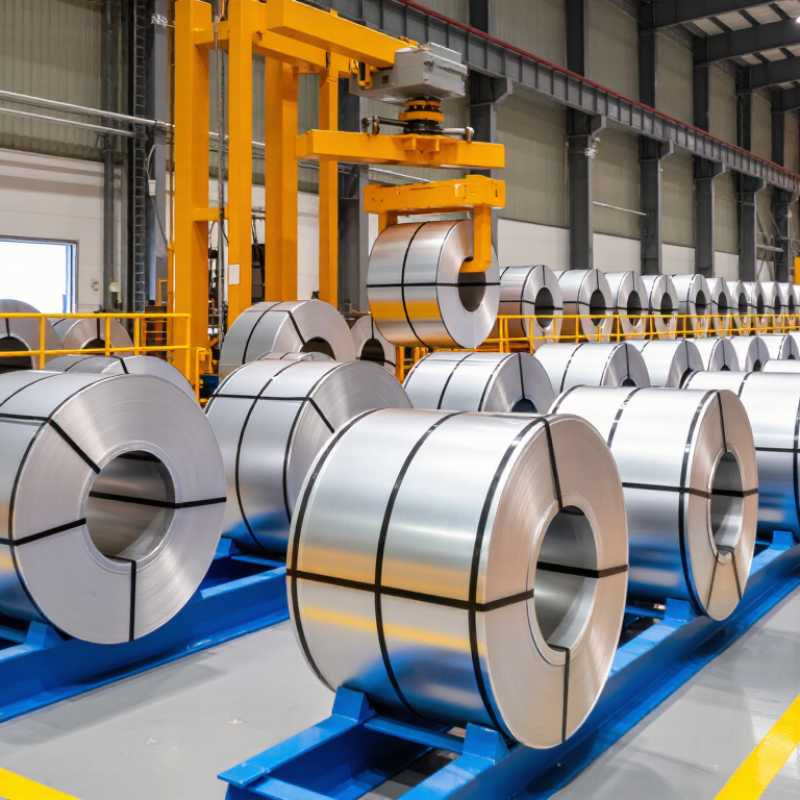
This guide evaluates ten Grade 304L stainless steel coil manufacturers through product capability, inspection systems, export experience, customization, delivery reliability, and after-sales support. It also considers details visible on a real production line, such as clean recoiling, protected edges, readable heat numbers, and consistent surface appearance under warehouse lighting. Reports from the International Stainless Steel Forum and established technical standards inform the comparison. However, public data can be incomplete, and some supplier claims deserve independent verification. That limitation matters. Buyers should request recent mill test certificates, sample coils, audit evidence, and clear explanations of lead times before signing contracts.
What Is Grade 304L Stainless Steel Coil?
What Is Grade 304L Stainless Steel Coil?
Grade 304L stainless steel coil is a flat-rolled austenitic material with low carbon content. ASTM A240/A240M commonly specifies carbon at 0.030% maximum. Chromium typically ranges from 18% to 20%, while nickel ranges from 8% to 12%. These elements support corrosion resistance, formability, and stable performance in many processing environments.
The “L” means low carbon. This detail matters during welding. Lower carbon reduces carbide precipitation near welded areas, helping limit intergranular corrosion. It does not make the coil corrosion-proof. Chlorides, poor cleaning, and rough surface damage can still cause problems. According to the International Stainless Steel Forum’s 2023 statistics, global stainless crude steel production reached about 58.4 million tonnes. That scale reflects broad demand, but it does not guarantee identical coil quality.
In practical purchasing, buyers should check thickness, width, surface finish, flatness, edge condition, and coil weight. Annealed and pickled coil often suits fabricated equipment, while cold-rolled finishes provide tighter dimensions and a smoother appearance. A bright surface can look impressive. It may still hide unsuitable mechanical properties or inconsistent tolerances. Test certificates should match the applicable standard and heat number. That step is often overlooked. For demanding service, verify corrosion conditions, forming requirements, and welding procedures before selecting 304L coil.
Top 10 Grade 304L Stainless Steel Coil Manufacturers? – What Is Grade 304L Stainless Steel Coil?
A manufacturer-neutral comparison table of Grade 304L stainless steel coil specifications, quality controls, and purchasing criteria
| No. | Evaluation Dimension | Verified Grade 304L Benchmark | What a Qualified Coil Manufacturer Should Provide | Common Reference |
|---|---|---|---|---|
| 1 | Material identity | Grade 304L is a low-carbon austenitic stainless steel. Its UNS designation is S30403, and its EN material number is commonly 1.4307. | The supplier should state the exact grade designation, heat number, applicable standard, and product form on the quotation and inspection documents. | ASTM A240; EN 10088-2 |
| 2 | Carbon content | Maximum carbon content is typically 0.030% by mass. The low carbon level helps reduce the risk of chromium-carbide precipitation during welding compared with standard 304. | Chemical analysis should be traceable to the heat number. A mill test certificate should report the measured carbon value, not only the nominal grade. | ASTM A240 / A480 |
| 3 | Typical chemical composition | ASTM-type limits commonly include: Chromium 18.0–20.0%, Nickel 8.0–12.0%, Manganese max. 2.0%, Silicon max. 0.75%, Phosphorus max. 0.045%, and Sulfur max. 0.030%. | The manufacturer should use controlled melting and provide a full heat-chemistry report covering all specified elements. | ASTM A240 |
| 4 | Minimum tensile strength | The minimum tensile strength for annealed 304L sheet, plate, and strip under ASTM requirements is approximately 485 MPa. | Mechanical test results should identify the test direction, specimen condition, lot or heat number, and test method. | ASTM A240 |
| 5 | Minimum yield strength and elongation | Typical ASTM minimums are 170 MPa yield strength and 40% elongation in 50 mm for annealed material. | A reliable producer should control annealing, rolling reduction, and tension leveling so that the supplied coil meets the ordered temper and mechanical requirements. | ASTM A240 |
| 6 | Hardness and delivery condition | ASTM A240 commonly lists a maximum hardness of approximately 92 HRB for annealed 304L. Cold-reduced products may have different mechanical properties when supplied in a specified temper. | The order should specify annealed, cold-rolled, skin-passed, or other required conditions. Hardness should be tested according to the agreed standard. | ASTM A240 / A480 |
| 7 | Surface finish | Common coil finishes include 2B for a smooth cold-rolled surface, BA for a bright annealed appearance, and No. 1 for a hot-rolled, annealed, and pickled surface. | Surface finish, roughness target, protective film, edge condition, and allowable surface defects should be clearly defined before production. | ASTM A480; EN 10088-2 |
| 8 | Dimensional control | Coil products are normally purchased by thickness, width, inside diameter, outside diameter, coil weight, and edge type. Tolerances depend on the selected product standard and ordered dimensions. | The supplier should provide calibrated thickness gauges, width measurement, flatness control, burr management, and dimensional inspection records for each production lot. | ASTM A480; EN 10051 |
| 9 | Weldability and corrosion performance | 304L is widely used for welded fabrications because its low carbon content reduces sensitization risk. It offers good general atmospheric and many chemical-environment corrosion resistance, but it is not immune to chloride pitting or stress-corrosion cracking. | The manufacturer should not make unrestricted corrosion-resistance claims. Application-specific testing, correct welding practice, cleaning, and passivation may be required. | ASTM A262; ASTM A967 |
| 10 | Documentation and traceability | A complete supply package normally includes a material test certificate, chemical composition, mechanical test results, dimensions, surface condition, heat number, quantity, and applicable standard. | The best-qualified supplier maintains heat-to-coil traceability, inspection records, packing records, and compliance documentation without relying on brand-based claims. | EN 10204 Type 3.1; ASTM A480 |