How to Choose Aluminum Profile for Pergola in 2026?

Choosing Aluminum Profile For Pergola in 2026 requires more than comparing catalog prices. The right section must match the roof span, wind exposure, snow load, drainage design, and intended use. A slim profile may look elegant beside a patio, yet it can deflect noticeably across a four-meter opening. That movement can loosen fasteners and disturb roof panels. Measure the site carefully. Record beam lengths, column spacing, local weather conditions, and nearby coastal exposure. Small errors matter.

Experienced installers usually begin with alloy and temper, not appearance. Common architectural choices include 6063 aluminum, while 6061 may suit parts needing higher strength. The final decision depends on engineering calculations, connection design, and supplier data. Check wall thickness, section modulus, allowable deflection, and tested load capacity. Ask for mill certificates, coating specifications, and installation tolerances. Powder coating should be suitable for exterior use, especially where salt, humidity, or intense sunlight is present. A beautiful finish cannot repair an undersized beam. Neither can a low price.

This guide explains how to compare profiles, accessories, and manufacturers for 2026 pergola projects. It considers thermal expansion, concealed gutters, adjustable louvers, corrosion control, and future maintenance. Reliable suppliers should provide drawings, material grades, load tables, warranty terms, and traceable quality records. Independent structural review is wise for large or exposed structures. Still, product brochures are not perfect. They may omit connection limits or assume ideal installation. Read the details, question the assumptions, and adapt the selection to the actual site. A careful choice feels solid before the first cut.
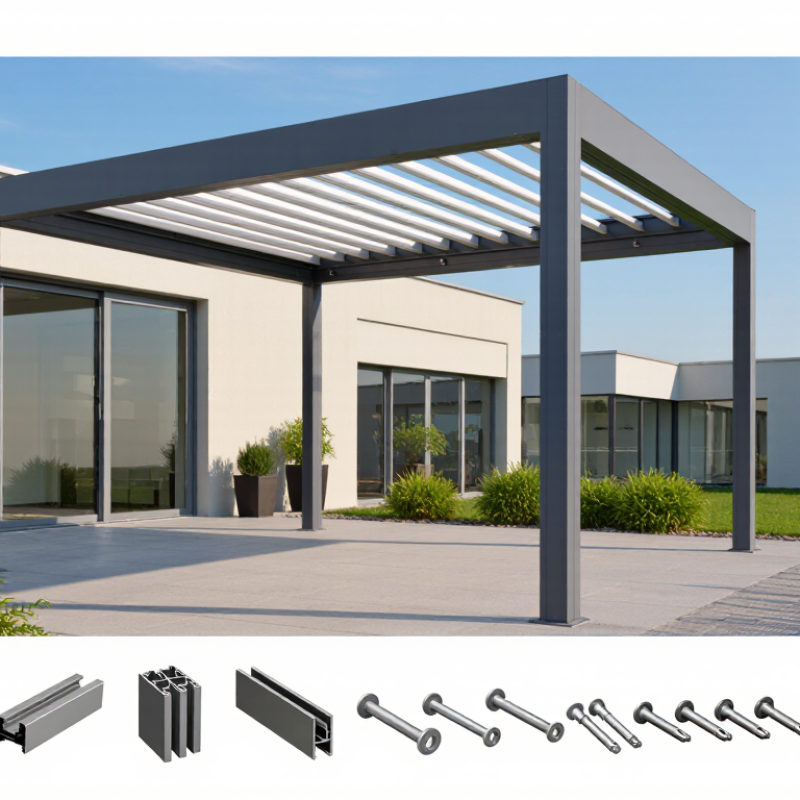
How to Choose Aluminum Profile for Pergola in 2026?

What an Aluminum Pergola Profile Is and Why It Matters

An Aluminum Pergola Profile is the shaped extrusion that forms beams, posts, rafters, and connecting rails.

It is not merely a decorative cover. The profile controls strength, drainage, appearance, and installation speed. A hollow section may look substantial, yet thin walls can flex under wind or carry less load. Dimensions matter.

Begin with the site conditions. Measure the span, roof type, local wind exposure, and expected rainwater flow. For larger openings, choose deeper beams or add internal reinforcement. Common architectural alloys, such as 6063-T5 or 6063-T6, offer good extrusion quality and corrosion resistance. However, alloy names alone do not prove performance. Ask for wall thickness, mechanical data, load calculations, and inspection records. Reliable suppliers should provide these details clearly.

Finish quality also matters. A powder-coated surface should cover corners evenly, without pinholes or exposed edges. Drainage channels need a real outlet, not just a hidden cavity. Leave room for thermal movement, because aluminum expands in strong sunlight. Small errors become visible around joints.

I have seen clean-looking frames fail because installers ignored water paths and fastener spacing. That is an uncomfortable lesson. Check it twice.

A profile can be technically strong but poorly suited to the project. Select the section after reviewing engineering data, connection details, and the installer’s actual skill.

How to Match Profile Strength with Pergola Size and Load

How to Choose Aluminum Profile for Pergola in 2026?

How to Match Profile Strength with Pergola Size and Load

Choosing an aluminum profile begins with the pergola’s clear span, not its appearance. A small patio cover may use slimmer beams, while a six-meter span needs deeper sections or intermediate posts. Longer spans increase bending and visible sag. They also amplify connection stress.

Calculate the dead load from profiles, roof panels, gutters, lighting, and accessories. Add local wind and snow loads from current building guidance. A solid roof catches more wind than open slats. In snowy regions, accumulated snow can become the controlling load. Coastal exposure also demands suitable corrosion protection and reliable fasteners.

Profile wall thickness matters, but geometry matters more. A deeper rectangular section usually resists bending better than a shallow, thick-walled section. Check the section’s moment of inertia, allowable deflection, and connection capacity. Do not judge strength by weight alone. A heavy profile can still perform poorly when its span is excessive.

On site, installers often discover that the posts are adequate, but the beam connections are weak. Bolts, brackets, base plates, and anchoring deserve equal attention. My first size estimate is sometimes revised after checking drainage, lighting cuts, and roof weight. That revision is useful. Ask a qualified structural professional to verify unusual spans, elevated decks, high-wind locations, or heavy roofs before fabrication. Numerical tables are helpful, but they cannot replace a project-specific review.

Which Aluminum Grades and Finishes Suit Outdoor Conditions

Choosing an aluminum pergola profile starts with the alloy, not the color chart. Alloy strength matters outdoors.

For most residential pergolas, 6063-T5 aluminum offers a smooth surface and reliable corrosion resistance. It is well suited to extrusion, curved beams, and visible architectural details. 6061-T6 provides higher strength, especially for long spans or heavy roof systems. However, it can be less forgiving during forming and may need more careful finishing. Wind exposure, snow load, and beam length should be checked by a qualified engineer. A thicker profile cannot replace proper structural design.

The finish protects the surface and shapes its appearance. Anodizing creates a hard oxide layer that resists fading and minor scratches. It keeps a natural metallic look. Powder coating provides broader color choices and can offer strong weather protection when pretreatment and curing are controlled. Ask for coating thickness, salt-spray results, and outdoor exposure data. Coastal projects need extra attention. Salt can attack unprotected cut edges and fastener connections. Use compatible stainless-steel hardware, isolate dissimilar metals, and provide drainage paths.

Small details matter. Water trapped inside a profile can cause staining or corrosion over time. A clean sample can mislead. Real corners, drilled holes, and joints deserve inspection. In practice, finish quality sometimes varies between batches, so written specifications and incoming checks are worth the effort. Dark colors may also become noticeably hotter in direct sun. That trade-off is easy to overlook.

How to Choose Aluminum Profile for Pergola in 2026? - Which Aluminum Grades and Finishes Suit Outdoor Conditions

Aluminum Grade Common Temper Typical Minimum Tensile Strength Typical Minimum Yield Strength Best Use in a Pergola Outdoor Corrosion Performance Recommended Finish Selection Notes
6063 T5 or T6 Approximately 186–207 MPa, depending on temper and section thickness Approximately 145–172 MPa, depending on temper and section thickness Standard posts, beams, rafters, louvers, decorative trims, and complex hollow profiles Very good atmospheric corrosion resistance; well suited to normal outdoor exposure Anodizing
Powder coating
Most common architectural choice because it offers a smooth surface, good extrusion quality, and an attractive appearance. Use engineering calculations for long-span beams.
6061 T6 Approximately 290 MPa Approximately 240 MPa Load-bearing posts, brackets, connectors, base plates, and heavily stressed structural members Good corrosion resistance, although generally less suited to highly decorative extrusion work than 6063 Powder coating
Anodizing
Provides higher strength than 6063-T5/T6. It can be more difficult to extrude into thin, intricate shapes, so confirm profile availability and surface requirements before specifying it.
6005A T5 or T6 Approximately 270–290 MPa, depending on temper and section thickness Approximately 225–255 MPa, depending on temper and section thickness Structural beams, posts, rafters, and medium-to-heavy duty extruded profiles Good outdoor corrosion resistance when properly finished and maintained Powder coating
Anodizing
A useful compromise between structural strength and extrusion capability. Confirm the applicable product standard because mechanical-property values vary with temper and wall thickness.
6060 T5 or T6 Approximately 160–190 MPa, depending on temper and section thickness Approximately 120–150 MPa, depending on temper and section thickness Light-duty trims, screens, small louvers, infill panels, and non-primary decorative components Very good atmospheric corrosion resistance Anodizing
Powder coating
Offers excellent surface quality and formability but is usually not the first choice for major structural members unless the design loads are low.
6063-T5 T5 Approximately 186 MPa Approximately 145 MPa Typical residential pergola frames and moderate-span extruded profiles Very good Anodizing
Powder coating
A practical option for many residential applications. Profile geometry, span, wind load, snow load, connection design, and wall thickness are as important as alloy selection.
6063-T6 T6 Approximately 205–214 MPa Approximately 170–172 MPa Higher-strength architectural posts, beams, and rafters made from 6063 extrusion shapes Very good Anodizing
Powder coating
Stronger than 6063-T5, but the final design still needs verification for deflection, buckling, fastener loads, and local building-code requirements.
Any suitable architectural alloy Specified by the supplier Must be confirmed against the applicable alloy and temper standard Must be confirmed against the applicable alloy and temper standard Coastal, marine, poolside, industrial, or high-pollution environments Higher exposure risk Anodizing: 18–25 μm
Powder coating: 60–80 μm
Use a high-quality, continuous finish, isolate aluminum from dissimilar metals, avoid water-trapping joints, and provide drainage. Specify a tested exterior coating system suitable for the local exposure category.
Finish: Anodized Not an alloy temper Does not materially increase the structural strength of the profile Does not materially increase the structural strength of the profile Projects prioritizing a metallic appearance, color stability, and low-maintenance surfaces Excellent when the anodic layer is continuous and correctly specified Typical exterior thickness: 15–25 μm Hard, integral oxide layer with a natural metallic look. Color matching can vary between production batches. Scratches cannot be easily repaired invisibly.
Finish: Powder Coated Not an alloy temper Does not materially increase the structural strength of the profile Does not materially increase the structural strength of the profile Projects requiring a wide range of colors, opaque coverage, or coordinated architectural finishes Very good when pretreatment, coating thickness, curing, and drainage are properly controlled Typical exterior thickness: 60–80 μm Provides strong color and design flexibility. Specify exterior-grade powder, suitable pretreatment, and a coating warranty appropriate for UV, humidity, and salt exposure.
Finish: PVDF Coated Not an alloy temper Does not materially increase the structural strength of the profile Does not materially increase the structural strength of the profile High-visibility projects with severe UV exposure, demanding color retention, or premium façade-style requirements Excellent weathering performance when the complete coating system is properly specified Typically multi-layer Usually selected for premium architectural durability. Confirm whether the coating is applied to extrusions and verify the specified resin, pretreatment, thickness, and performance warranty.

Property values are representative values and can vary with the governing standard, temper, wall thickness, profile geometry, and supplier. Final pergola sizing should be verified using local wind, snow, seismic, span, deflection, connection, and building-code requirements.

How to Select Profile Shape, Thickness, and Connection Methods

How to Choose Aluminum Profile for Pergola in 2026?

For a pergola, profile shape affects stiffness, drainage, and visual weight. Rectangular hollow sections usually resist bending better than equal-sized angles. Deeper profiles can reduce deflection across long spans. However, oversized sections may look heavy and increase material costs. Measure the span, roof weight, wind exposure, and expected snow load before selecting a shape. A simple sketch is not enough.

Thickness must match the load path, not only the outside appearance. Thin walls may dent around bolts or deform during installation. Thicker walls improve screw engagement, but they do not solve poor structural design. In many projects, 2 to 3 millimeters is only a starting range. Actual sizing requires load calculations and local engineering review. This deserves a second check.

Connection details often decide long-term performance. Bolted joints with plates or internal sleeves allow controlled assembly and easier replacement. Use compatible stainless fasteners, isolation washers, and sealed contact points to reduce galvanic corrosion. Leave room for thermal movement. Add drainage paths where water could collect inside hollow profiles. A neat joint can still hide weak load transfer. Site inspections frequently find loose fasteners, blocked drains, or unsupported corners. Small errors matter. Recheck every connection after the first season.

How to Compare Costs, Maintenance, and Long-Term Performance

How to Choose Aluminum Profile for Pergola in 2026?

Compare more than the purchase price. A thin aluminum profile may look economical, yet it can require extra posts, stronger connectors, or earlier replacement. Ask suppliers for alloy grade, wall thickness, span tables, coating specification, and installation costs. A 2024 International Aluminium Institute report projects global aluminum demand could rise by about 80% by 2050. Supply pressure may affect future pricing. My practical view is simple: compare complete systems, not isolated profiles.

Maintenance is usually predictable, but not zero. Rinse exposed surfaces several times yearly, especially near saltwater or heavy traffic pollution. Use mild detergent and soft tools. Avoid aggressive chemicals and abrasive pads. Coatings tested under AAMA 2605 provide stronger color and chalk resistance than basic finishes, but local exposure still matters. Inspect drainage paths, fasteners, and joints after storms. Small defects become expensive when ignored.

Long-term value also depends on recycled content and repairability. The Aluminum Association reports that recycling aluminum uses about 95% less energy than producing primary aluminum. Ask for documented recycled content and a clear recycling route. The lowest quote may still be reasonable, but only when engineering data supports it. I would not promise maintenance-free performance. That claim deserves skepticism.

Request a Quote

For more information on our instruments, consumables, or services, or to request a quote, complete the contact form below, and one of our associates will reach out to you!

Request a Service Quote

To request service on your machine(s), complete the contact form below, and one of our associates will reach out to you!

Browse by:

  • Test Property
  • Manufacturer