How to Choose the Right Polymeric Surge Arrester?
Choosing the right Polymeric Surge Arrester requires more than comparing catalog prices. It demands a clear understanding of system voltage, grounding conditions, insulation levels, and exposure to lightning or switching surges. A suitable arrester must limit overvoltage without interrupting normal service. Small details matter.
In substations and overhead distribution networks, engineers often begin with the maximum continuous operating voltage. They then check the temporary overvoltage profile and required discharge capability. An arrester with the wrong rating may age prematurely, especially during repeated faults. That risk is easy to underestimate. I have seen specifications that looked acceptable until field pollution, installation height, and cable length were reviewed together.
Polymeric housings offer practical advantages, including lighter weight, strong contamination performance, and reduced damage risk during handling. However, these benefits depend on design quality, sealing, shed geometry, and verified manufacturing control. The housing alone does not guarantee reliable protection. Selection should reference applicable requirements, such as IEC 60099-4, alongside utility practices and site-specific test data. Manufacturer documentation should clearly state residual voltage, energy capability, thermal stability, and environmental limitations.
This guide examines how to compare these factors in a disciplined way. It also considers coordination with transformers, cables, and other insulation systems. A technically correct choice can still fail if installation practices are poor. That uncomfortable point deserves attention. The best decision combines calculated protection levels, realistic operating conditions, independent technical review, and evidence from proven service experience. Cost remains relevant, but lifecycle reliability should carry greater weight.
Understanding the Role of a Polymeric Surge Arrester
How to Choose the Right Polymeric Surge Arrester?
Understanding the Role of a Polymeric Surge Arrester
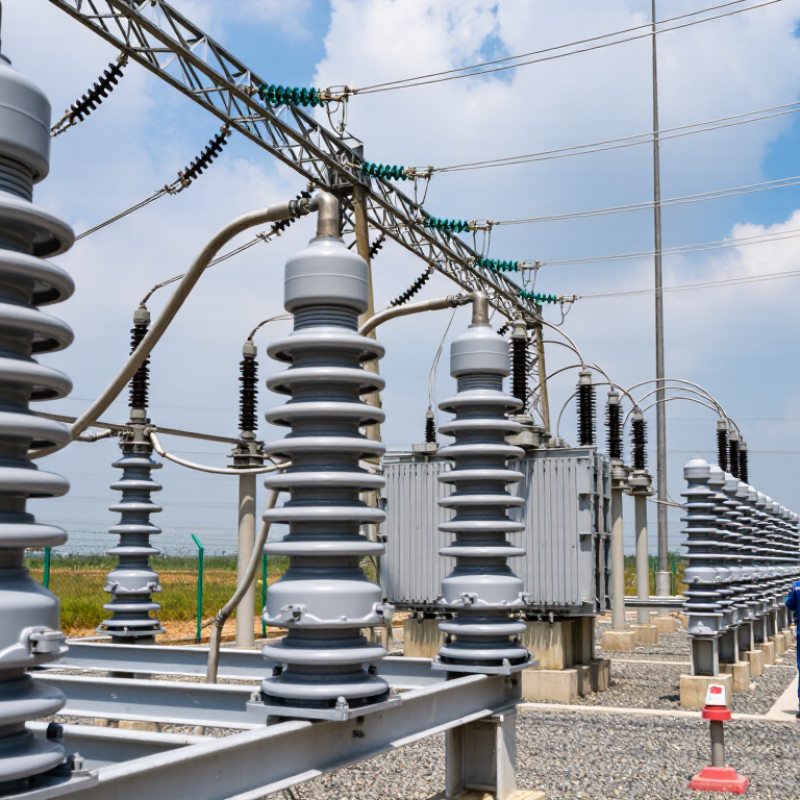
A polymeric surge arrester protects electrical equipment from damaging overvoltage. Its role is simple, but its operating conditions are not. During a lightning strike or switching event, the arrester creates a low-resistance path to ground. This diverts surge energy away from transformers, cables, and other valuable equipment.
The metal-oxide varistor inside the arrester responds within microseconds. Under normal voltage, it remains highly resistive. When voltage rises sharply, its resistance drops and limits the stress across connected equipment. Then it returns to its normal state. This fast response is the arrester’s main working advantage.
The polymeric housing provides insulation and weather protection. It is lightweight, hydrophobic, and less likely to break into dangerous fragments than some rigid housings. Its surface also helps shed rain and pollution. That detail matters in coastal, industrial, and dusty locations.
Selection should match the system voltage and grounding method. Temporary overvoltage matters too. Pollution level, creepage distance, and altitude deserve careful review. Mechanical loading cannot be ignored on exposed poles. In coastal areas, salt deposits may reduce performance over time.
Installation matters. Loose terminals, poor grounding, or excessive cable length can weaken protection. Field inspections often reveal these practical problems. A well-rated arrester can still perform poorly when installation details are rushed.
No selection method is flawless. That is worth remembering. Engineers should compare test data, operating history, and site conditions instead of trusting one number. A small weakness in the application can become a large failure during a severe surge.
Identifying System Voltage and Surge Protection Requirements
Choosing a polymeric surge arrester starts with the network, not the catalog. Identify the highest system voltage, grounding method, and temporary overvoltage exposure. Do not select from nominal line voltage alone. IEC 60099-4 separates rated voltage from continuous operating voltage, and this distinction affects thermal stability and insulation coordination. Record the transformer neutral connection, fault-clearing time, and expected switching events. Small details matter.
Lightning is only one part of the requirement. NOAA reports roughly 20 million cloud-to-ground lightning flashes across the contiguous United States each year. NERC’s 2024 Long-Term Reliability Assessment projects North American summer peak demand to increase by about 15% over ten years. Higher loading and changing power flows may increase switching stresses. Review lightning exposure, cable lengths, substation shielding, pollution, altitude, and insulation levels before choosing MCOV, rated voltage, residual voltage, and energy capability. A practical warning: field labels are sometimes incomplete. A clean drawing can still hide an incorrect grounding assumption. That mistake is easy to make. Verify it with measurements, protection studies, and the latest utility data. The arrester should coordinate with the protected equipment’s BIL, not merely match the system voltage. Its polymer housing also needs suitable creepage distance and weather resistance for the installation site. Requirements are rarely identical across feeders.
How to Choose the Right Polymeric Surge Arrester?
Identify the system voltage first, then select an arrester with a continuous operating voltage (Uc/MCOV) above the highest expected line-to-ground voltage. The values below are practical screening references for common low-voltage AC systems; final selection must consider grounding, temporary overvoltage, coordination, and applicable standards.
Selection principle: The arrester’s Uc/MCOV must not be lower than the maximum steady-state voltage it may experience. Higher exposure to lightning or switching surges generally requires a higher discharge-current rating and coordinated upstream and downstream protection.
Comparing Arrester Ratings, Construction, and Performance
How to Choose the Right Polymeric Surge Arrester?
Selecting a polymeric surge arrester requires more than matching a voltage label. Start with the system’s maximum continuous operating voltage, or MCOV. The arrester’s rating must tolerate normal voltage and temporary overvoltage events. A higher rating is not automatically safer. It may allow excessive residual voltage during a lightning surge. Check discharge current, energy capability, and protective level together. These values should suit the transformer insulation and local lightning exposure.
Construction strongly influences field reliability. A polymeric housing is lightweight and resists shattering, which simplifies handling near substations and overhead equipment. Its silicone surface can recover hydrophobicity after contamination. However, damaged sheds can create tracking paths. Inspect the sealing system, pressure-relief design, metal-oxide blocks, and internal support structure. Small manufacturing weaknesses may remain invisible until moisture enters. That possibility deserves attention.
Performance testing should follow recognized requirements, such as IEC 60099-4 or IEEE C62.11. Look for evidence of thermal stability, aging resistance, pollution performance, and repeated impulse capability. Site conditions matter too. Coastal salt, industrial dust, altitude, and limited clearances can change the selection. During maintenance, compare leakage-current trends, housing condition, and connection tightness. A single reading can mislead. A recurring pattern is more useful. Field experience shows that installation errors sometimes weaken an otherwise capable arrester. The specification may be sound, but the application can still be wrong.
Assessing Installation Conditions and Environmental Exposure
How to Choose the Right Polymeric Surge Arrester?
Assessing Installation Conditions and Environmental Exposure
Choosing a polymeric surge arrester begins with the installation environment. The arrester must match the system voltage and continuous operating voltage. A rooftop unit faces direct sunlight, wind, rain, and temperature changes. High-altitude sites may require additional attention to air clearance and insulation performance. Do not rely on voltage ratings alone. Field experience shows that small site details often affect long-term reliability.
Environmental exposure can change the arrester’s service life. Salt deposits may form a conductive film on coastal equipment. Industrial dust and chemical pollution can increase surface leakage. Select housing materials with strong resistance to ultraviolet radiation, moisture, and tracking. Temperature matters too. In cold regions, ice and repeated freezing can stress seals and mounting points. I have seen inspections focus on electrical ratings while ignoring nearby exhaust outlets. That oversight can be expensive.
Installation quality is equally important. Check phase-to-ground clearances before energizing the line. Keep connections short, direct, and free from sharp bends. A long lead can raise residual voltage during a fast surge. Confirm that the grounding path is low impedance and securely bonded. Inspect clamps, brackets, and cable connections for vibration or corrosion. A checklist helps, but it can miss unusual conditions. Recheck the site after severe weather, because the original assessment may no longer describe reality.
How to Choose the Right Polymeric Surge Arrester? - Assessing Installation Conditions and Environmental Exposure
| Installation / Exposure Condition | Typical Site Characteristics | Selection Considerations | Practical Starting Point | Required Verification |
|---|---|---|---|---|
| Indoor substation or switchgear | Clean, dry, limited UV exposure; controlled access; low risk of salt or industrial contamination. | Focus on system voltage, temporary overvoltage withstand, short-circuit capability, and correct connection clearances. | Standard silicone-rubber housing with the creepage distance required for the actual indoor pollution level. | Confirm coordination with transformer, cable, and switchgear insulation levels; check enclosure ventilation and terminal clearances. |
| Outdoor distribution line | Rain, sunlight, wind, dust, temperature cycling, and possible ice or snow. | Use a weather-resistant polymeric housing, hydrophobic silicone surface, sealed interfaces, and adequate mechanical strength. | Select an outdoor arrester tested for environmental sealing, UV exposure, mechanical loading, and leakage-current stability. | Check line hardware loads, conductor movement, mounting orientation, pollution severity, and local minimum temperatures. |
| Coastal or salt-contaminated area | Salt deposits, high humidity, wind-driven spray, frequent wetting, and elevated surface conductivity. | Increase creepage distance and use a housing with stable hydrophobicity and strong resistance to salt-fog aging. | Use a pollution-specific creepage design rather than selecting only by nominal system voltage; consider periodic washing where applicable. | Classify the site according to the applicable pollution-severity method and review salt-fog, wet-power-frequency, and housing-aging test evidence. |
| Industrial pollution zone | Conductive dust, chemical deposits, combustion by-products, or emissions from industrial processes. | Prioritize contamination performance, creepage distance, hydrophobic recovery, and resistance to chemical attack. | Choose an arrester with pollution-class data and a creepage distance suitable for the measured or assessed contamination level. | Evaluate chemical compatibility, deposit conductivity, cleaning intervals, and the possibility of surface discharge or tracking. |
| High-altitude installation | Reduced air density affects external insulation clearances and may increase cooling constraints. | The arrester electrical characteristics may remain suitable, but external air clearances and insulation coordination require altitude correction. | For sites above approximately 1,000 m, review altitude correction factors specified by the relevant installation standard. | Confirm phase-to-earth and phase-to-phase clearances, creepage requirements, thermal performance, and applicable utility rules. |
| High lightning-density region | Frequent lightning activity, exposed lines, poor shielding, or high ground-flash density. | Consider higher energy capability, short lead connections, low residual voltage, and suitable line-discharge performance. | Use an arrester class and energy rating supported by lightning and network studies, not by voltage rating alone. | Assess line length, tower footing resistance, shielding, backflashover risk, and the number of expected surge events. |
| Transformer terminal installation | Arrester installed close to a transformer bushing, often with short but inductive connecting leads. | Low residual voltage and minimal lead length are important because surge voltage increases with lead inductance. | Mount the arrester as close as practicable to the protected terminal; keep phase and earth leads short and direct. | Verify protection distance, lead routing, grounding impedance, transformer impulse withstand level, and terminal clearances. |
| Motor, generator, or cable-connected equipment | Fast-front transients, cable reflections, switching surges, and possible repetitive operation. | Select suitable discharge characteristics and ensure the arrester does not experience excessive temporary overvoltage or thermal stress. | Install at the equipment terminals or at the cable transition point, with attention to cable length and surge travel time. | Study switching transients, cable configuration, grounding method, motor insulation class, and repetitive surge frequency. |
| Network with frequent temporary overvoltages | Earth faults, load rejection, ferroresonance, resonance, or isolated-neutral operation may produce sustained overvoltage. | The maximum continuous operating voltage (MCOV) must withstand the highest continuous phase-to-earth voltage; short-duration TOV capability must also be checked. | Select MCOV from the actual grounding and fault-clearing conditions, not simply from the nominal line voltage. | Calculate earth-fault factor, fault duration, neutral treatment, system frequency, and arrester thermal recovery capability. |
| Cold, hot, or severe temperature environment | Outdoor temperatures may range from below −40 °C to above 40 °C, depending on the site. | Housing materials, seals, pressure-relief behavior, and thermal stability must match the specified service temperature range. | Specify the complete minimum and maximum operating temperature, including solar heating and enclosure effects. | Review temperature-cycle testing, thermal stability, ice loading, seal performance, and manufacturer-declared service limits. |
| Areas exposed to vandalism or mechanical impact | Public access, vehicle movement, construction activity, or risk of falling objects. | Polymeric housings reduce shattering risk compared with brittle porcelain, but mechanical strength and mounting design remain essential. | Use a mechanically robust arrester with protected mounting, secure terminals, and suitable cantilever or tensile ratings. | Check impact exposure, conductor forces, mounting hardware, enclosure protection, and safe failure or pressure-relief behavior. |
| Typical medium-voltage system example | Three-phase 11 kV network with effectively grounded neutral and outdoor line exposure. | A commonly evaluated starting point is an arrester with approximately 7.65 kV MCOV and 10 kV rated voltage, subject to system studies. | Select the actual MCOV, rated voltage, discharge class, housing creepage, and energy capability for the network configuration. | Confirm grounding, fault duration, insulation coordination, pollution level, lightning exposure, and the required residual-voltage margin. |
| Typical medium-voltage system example | Three-phase 33 kV network with outdoor substation or line equipment. | A commonly evaluated starting point is an arrester with approximately 24.4 kV MCOV and 30 kV rated voltage, subject to system studies. | Use the network’s actual phase-to-earth voltage, temporary overvoltage profile, and insulation coordination results. | Verify neutral grounding, earth-fault clearing time, switching-surge severity, pollution classification, and transformer withstand level. |
Selecting a Reliable Arrester and Verifying Its Maintenance Needs
How to Choose the Right Polymeric Surge Arrester?
Selecting a polymeric surge arrester requires more than checking its voltage rating. The housing must suit pollution, ultraviolet exposure, humidity, and mechanical stress. IEC 60099-4:2014+A1:2016 requires routine production tests, including checks related to metal-oxide varistor performance. CIGRE Technical Brochure 549 also emphasizes system voltage, temporary overvoltage, and energy duty during selection. These values should match the installation, not a generic catalogue table.
Maintenance needs deserve equal attention. During field inspections, technicians should examine torn sheds, chalking, tracking marks, loose terminals, and water paths near the sealing area. Infrared scans can reveal abnormal heating, while leakage-current measurements may indicate ageing when interpreted with weather conditions. IEEE C62.11-2020 covers key performance tests, including residual-voltage and energy-duty verification. Keep inspection records with date, temperature, rainfall, leakage readings, and photographs. Small changes matter.
A high leakage value may reflect surface contamination, not internal damage. Conversely, a clean appearance can hide moisture ingress. Maintenance intervals should follow the manufacturer’s tested design, site severity, and utility experience. Some installations need annual visual checks; heavily polluted sites may need shorter cycles. I would also review the grounding connection after storms, because an excellent arrester cannot compensate for a poor discharge path. Controls are useful, but they are not perfect. The maintenance plan should be revised after every unusual surge, outage, or failed inspection.
Article Source:
Have Questions? We're Here to Help!
Give us a call at (864) 989-0566 or send us a message to discuss our testing equipment with an expert.