China Top 10 Pure Water Machine Manufacturers
China’s Pure Water Machine industry has expanded rapidly, serving homes, offices, laboratories, restaurants, and industrial facilities. Yet, choosing a reliable manufacturer requires more than checking production volume or export claims. A polished website cannot replace verified testing, stable component quality, and responsive technical support.
Dr. Joseph Cotruvo, a recognized drinking-water quality expert, states, “The goal is to protect public health.” This principle should guide every manufacturer comparison. A dependable Pure Water Machine should show clear filtration stages, realistic flow rates, membrane specifications, and measurable contaminant-reduction performance. It should also support safe installation, routine maintenance, and transparent replacement schedules.
This overview examines China’s top 10 Pure Water Machine manufacturers through practical criteria. These include manufacturing experience, product consistency, certifications, quality-control systems, research capability, customization, energy use, and after-sales service. Factory audits and independent test reports deserve particular attention. Marketing language alone is not enough.
Performance varies.
Some manufacturers excel in reverse osmosis systems, while others focus on ultrafiltration, commercial dispensers, or integrated water plants. Their strengths may not match every buyer’s requirements. A compact office unit cannot be judged like a high-capacity industrial system. This guide also has limits, because product specifications and certifications can change over time. Buyers should confirm current documents before signing contracts.
The ranking is therefore a practical reference, not an absolute verdict. It highlights manufacturers that appear capable, experienced, and suitable for different purchasing scenarios. Evidence matters. Clear records, service coverage, and honest technical communication often reveal more than impressive sales language.
China’s Top 10 Pure Water Machine Manufacturers: Scope and Selection Criteria
China’s Top 10 Pure Water Machine Manufacturers: Scope and Selection Criteria
This selection covers Chinese manufacturers producing household, commercial, and light industrial pure water machines. The scope includes reverse osmosis systems, ultrafiltration units, remineralization equipment, and integrated filtration cabinets. The WHO/UNICEF Joint Monitoring Programme reported that 2.2 billion people lacked safely managed drinking water in 2022. That figure shows why product reliability matters beyond appearance.
The evaluation uses measurable criteria. Manufacturing experience includes plant capacity, process control, and documented quality records. Technical assessment examines recovery rate, contaminant reduction, membrane life, energy use, and noise. Compliance checks should include applicable Chinese GB standards and recognized international testing procedures. Factory audits also review incoming-material inspection, pressure testing, batch traceability, and worker training. Independent laboratory results carry more weight than promotional claims. Small details matter.
Service capability receives equal attention. Buyers should verify spare-part availability, installation guidance, warranty terms, and response times in export markets. Public trade data and audited company information can support the review, but some figures remain self-reported. That weakness deserves attention. A manufacturer may show impressive annual output while offering limited technical support after shipment. Selection should therefore combine factory visits, sample testing, customer interviews, and document verification. The top ten should represent dependable performance, transparent evidence, and practical suitability rather than market visibility alone.
RO Technology Benchmarks: 90–99% Salt Rejection and NSF/ANSI 58
When comparing China’s top 10 pure water machine manufacturers, RO performance deserves more than a catalog percentage. A strong benchmark is 90–99% salt rejection, measured under controlled conditions. Feedwater temperature, pressure, pH, and total dissolved solids can change the result. Real kitchens are rarely so consistent.
A reliable manufacturer should provide membrane test data, operating limits, and batch traceability. Independent laboratory reports add useful evidence. NSF/ANSI 58 is an important reference for residential reverse osmosis systems, especially material safety, structural integrity, and performance claims. However, certification must match the exact model, configuration, and production site. A similar-looking unit may not carry the same approval.
During practical checks, technicians can record inlet pressure and compare feedwater with treated water using a calibrated TDS meter. A rejection rate near 95% is often meaningful when conditions are documented. Flow rate and wastewater volume also matter. A machine may show excellent rejection but feel slow at the tap. That is a real weakness. Maintenance records should include filter changes, membrane age, and sanitation procedures. Some evaluations still rely too heavily on factory figures. That deserves more scrutiny. Manufacturers with clear manuals, responsive technical support, and verifiable certification usually offer greater confidence to distributors and end users.
Manufacturer Profiles: Products, Certifications, Capacity, and Export Markets
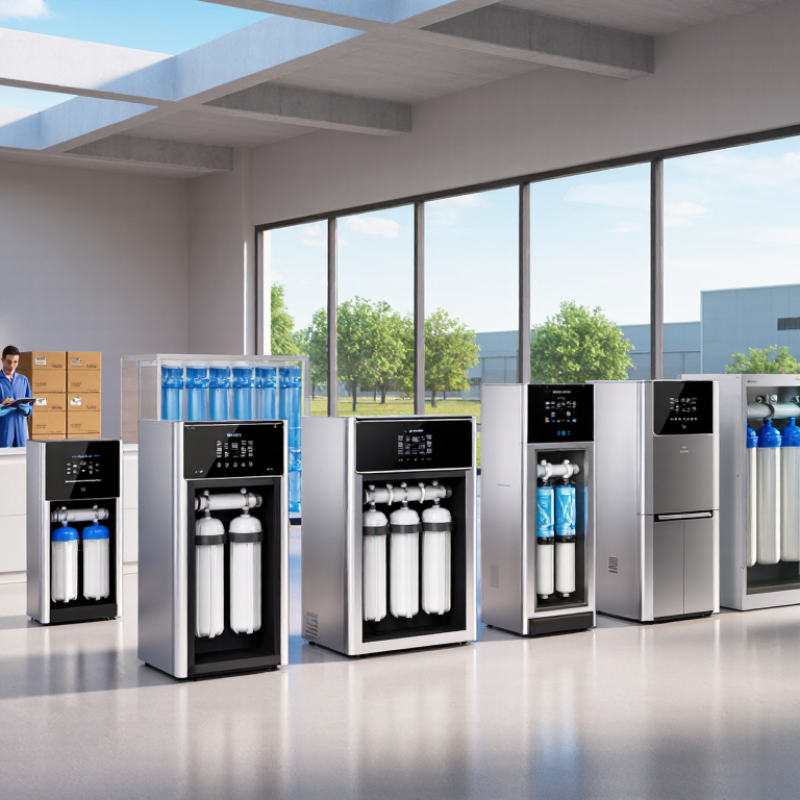
China’s leading pure water machine manufacturers usually serve homes, offices, laboratories, and light industrial sites. Their product ranges may include reverse osmosis units, ultrafiltration systems, mineral water dispensers, and stainless steel commercial machines. Experienced factories often support private labeling, custom voltage, multilingual manuals, and replacement filter programs. These details matter after installation, not only during purchasing.
A reliable manufacturer profile should identify verified certifications and their scope. Common evidence includes ISO 9001 for quality management, CE documentation for applicable markets, and food-contact reports for wetted components. Certification alone is not enough. Buyers should check certificate numbers, issuing bodies, and matching model specifications. Production capacity may range from several hundred household units to thousands of commercial systems monthly. However, capacity figures can be difficult to compare. Some factories count assembly output, while others report completed, tested machines.
Export experience provides another useful measure. Established suppliers may ship to Southeast Asia, the Middle East, Africa, Europe, and North America. Their teams should understand local voltage, water conditions, packaging rules, and after-sales expectations. Factory visits can reveal testing benches, membrane storage, leak checks, and actual inventory. Product photographs are less persuasive. A manufacturer may display advanced equipment yet outsource critical parts. This is worth questioning. A strong profile therefore combines product evidence, audit records, transparent capacity data, and references from comparable markets. Industry claims still require independent verification.
Performance Comparison Using GB 34914-2021 Water-Efficiency Grades
China Top 10 Pure Water Machine Manufacturers
Performance Comparison Using GB 34914-2021 Water-Efficiency Grades
A fair comparison of China’s top ten pure water machine manufacturers should begin with GB 34914-2021. This Chinese standard establishes water-efficiency labeling requirements for household water purifiers. Its grading system generally places Grade 1 at the highest efficiency level. Grade 5 represents the lowest qualifying level. A higher grade usually means better purified-water output and less wastewater under tested conditions.
The label should be checked beside the laboratory report. Important details include rated purified-water volume, water purification efficiency, inlet pressure, and test temperature. These figures help buyers compare similar reverse-osmosis machines more accurately. A machine producing one liter of drinking water from less feedwater may reduce daily water waste. That difference becomes visible beside a kitchen sink. Small differences matter.
Real homes are less predictable. Water pressure changes. Filters become blocked. Maintenance is often delayed. Therefore, a strong factory ranking should not rely on efficiency grade alone. Testing experience shows that installation quality and timely filter replacement can affect actual performance. The standard provides a reliable baseline, but it cannot reproduce every household. That limitation matters. Buyers should verify the official efficiency label, current test documentation, replacement-filter costs, and local service coverage before making a final comparison.
China Top 10 Pure Water Machine Manufacturers - Performance Comparison Using GB 34914-2021 Water-Efficiency Grades
Reference comparison based on the national water-efficiency grading thresholds for reverse-osmosis water purifiers. No company or brand performance data is displayed.
The net water production rate represents the percentage of input water converted into treated water. Under GB 34914-2021, Grade 1 indicates the highest water efficiency, while Grade 5 is the minimum graded level. Actual product classification must be verified through standardized testing.
After-Sales Service, Filter Life, Pricing, and Commercial Applications
China Top 10 Pure Water Machine Manufacturers
Choosing among China’s top ten pure water machine manufacturers requires more than comparing catalog prices. After-sales support often determines the real operating cost. Ask whether technicians respond within 24 to 48 hours. Confirm spare-part availability, installation guidance, and remote troubleshooting. A supplier should provide wiring diagrams, maintenance records, and clear warranty terms. Vague promises create expensive delays.
Filter life depends on feed-water quality, usage, and maintenance habits. Sediment filters commonly last three to six months. Carbon cartridges may serve six to twelve months. Reverse-osmosis membranes can last eighteen to thirty-six months under stable conditions. These figures are not guarantees.
A simple TDS meter, pressure gauge, and service log can reveal early problems. I have seen buyers trust replacement dates too much. Testing water quality is wiser than following a fixed calendar.
Pricing changes with flow rate, pretreatment, automation, stainless-steel construction, and certification needs. A small office unit may cost far less than a system serving a hotel or food facility. Commercial users should compare total ownership cost, not only the initial quotation.
Restaurants need steady output during busy hours. Clinics may require stronger disinfection controls. Laboratories often need tighter water-quality monitoring. A low quote can hide costly membranes, weak pumps, or difficult-to-source filters. That mistake is easy to make.
Before ordering, request a sample maintenance schedule and a written list of consumables.