2026 Best Packaging Paper Bags for Wholesale Buyers
Wholesale buyers choosing Packaging Paper Bags for 2026 face a practical challenge: balancing shelf appeal, carrying strength, cost, and reliable supply. Demand is not the only useful signal. Eurostat’s 2022 packaging-waste data reports an 83.2% recycling rate for paper and cardboard packaging across the European Union. That figure shows established recovery infrastructure, but it does not prove that every bag is recyclable in every local system. Materials and coatings matter.
For procurement teams, the details start with the bag’s job. A small retail bag may need neat folds and crisp printing; a grocery bag needs dependable handles and a reinforced base. Ask suppliers for paper weight, recycled-fiber content, handle construction, print limits, minimum order quantities, and production lead times. Request samples, then test them with the products and loads customers will actually carry. Small checks prevent costly surprises.
Price alone is a weak guide. A lower unit cost can lose its appeal if bags arrive late, vary between batches, or fail under ordinary use. Still, no specification sheet can fully predict real-world performance. That part deserves honest testing. This guide compares common paper grades, styles, and supplier considerations to help wholesale buyers make informed choices—not simply select the cheapest option.
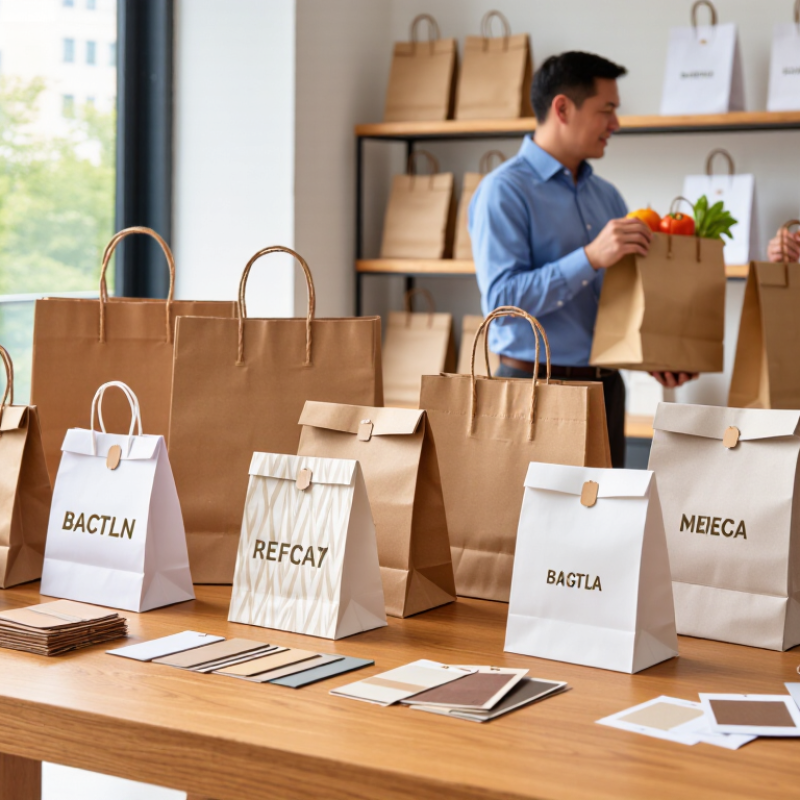
Paper Bag Types and Typical 70–120 g/m² Kraft Paper Grades
Wholesale buyers should match bag style and kraft paper weight to the product, not just the price. SOS bags suit groceries and takeaway items, while flat-handle bags work for lighter retail purchases. Twisted-handle bags feel sturdier in hand, but their performance also depends on handle attachment and bottom construction.
Kraft paper is often specified by basis weight, measured in grams per square metre (g/m²). Around 70–80 g/m² is a lighter option for small, low-weight goods. Grades near 90–100 g/m² offer a practical middle ground for many everyday bags. Paper around 110–120 g/m² can provide a firmer feel for heavier contents, though it may raise material and shipping costs. These ranges are guides, not guarantees. A neat empty sample can still feel flimsy once filled; this detail is easy to underestimate.
Tips: Request samples in the intended size and paper weight. Fill them with a realistic load, then check the handles, seams, and base. Test again after carrying. It takes a little effort, but it can reveal problems a specification sheet misses.
Match Paper Weight, Bag Dimensions, Handles, and Load Capacity
For wholesale orders, specify paper weight and finished dimensions together. A 100 gsm sheet may suit lightweight clothing, but jars or stacked books need stronger paper, reinforced bases, and secure handle attachments. Paper weight alone cannot predict capacity. Bag width, gusset depth, seams, and moisture all matter.
Start with the actual product. Measure its footprint and height, then allow room for easy packing. A 320 × 120 × 260 mm bag, for example, may fit a boxed item but feel cramped once tissue is added. Choose flat or twisted-paper handles based on how the bag will be carried. Test filled samples with real products, including a brief lift and walk. Small detail. A weak base seam can undo a heavier paper specification.
Eurostat reported that the EU generated 83.4 million tonnes of packaging waste in 2022, with paper and cardboard making up 40.8% (Eurostat, “Packaging Waste Statistics,” 2024). That scale makes material efficiency worth considering, but lighter is not automatically better. Ask suppliers for grammage, dimensions, handle construction, and tested load capacity. Record how samples perform after storage and handling; humidity can change the result. There is no perfect specification, and a first sample may expose a sizing mistake.
2026 Best Packaging Paper Bags for Wholesale Buyers — Match Paper Weight, Bag Dimensions, Handles, and Load Capacity
| Bag Type | Typical Paper Weight | Common Dimensions (W × G × H) | Handle or Closure | Typical Load Capacity* | Suitable Uses |
|---|---|---|---|---|---|
| Small SOS kraft bag | 70–90 gsm kraft paper | 180 × 100 × 250 mm | Flat paper handles or no handle | 1–3 kg (2–7 lb) | Takeaway orders, small groceries, snacks, and lightweight retail items |
| Medium grocery paper bag | 80–100 gsm kraft paper | 260 × 170 × 300 mm | Flat paper handles; reinforced handle area recommended | 3–6 kg (7–13 lb) | Packaged food, pharmacy purchases, and everyday retail |
| Large grocery paper bag | 100–120 gsm kraft paper | 320 × 200 × 350 mm | Flat paper handles or twisted paper handles | 5–8 kg (11–18 lb) | Groceries, boxed goods, and larger shopping orders |
| Medium retail shopping bag | 120–150 gsm kraft paper | 250 × 120 × 330 mm | Twisted paper handles with an interior reinforcement patch | 4–7 kg (9–15 lb) | Clothing, books, cosmetics, and general merchandise |
| Large retail shopping bag | 140–180 gsm kraft paper | 350 × 150 × 400 mm | Twisted paper handles with reinforced attachment points | 6–10 kg (13–22 lb) | Bulky apparel, shoes, gift boxes, and mixed retail purchases |
| Wide-bottom bakery bag | 50–70 gsm kraft paper | 220 × 120 × 280 mm | No handle; folded or sealed top | 1–2 kg (2–4 lb) | Bread, pastries, and other lightweight bakery products |
| Small gift bag | 120–160 gsm kraft paper | 180 × 100 × 230 mm | Twisted paper or paper-cord handles; optional reinforcement patch | 2–4 kg (4–9 lb) | Small gifts, accessories, and packaged specialty items |
| Heavy-duty merchandise bag | 160–200 gsm kraft paper | 400 × 180 × 450 mm | Strong twisted paper handles with reinforced top and base | 8–12 kg (18–26 lb) | Large retail products and heavier boxed items |
*Load capacities are approximate planning ranges, not guaranteed ratings. Actual performance depends on paper grade, bag construction, handle attachment, moisture, load shape, and carrying conditions. Confirm capacity with a sample test using the intended product and packing method.
Check Material Strength with ISO 536 Basis-Weight and ISO 2758 Burst Tests
2026 Best Packaging Paper Bags for Wholesale Buyers
A useful wholesale check starts with the paper, not the bag’s appearance. ISO 536 determines grammage: the mass of paper per square metre, usually reported in g/m². Higher grammage can mean more material, but it does not automatically mean a stronger bag. Fibre quality, recycled content, sheet formation, and moisture all influence performance.
Ask suppliers for recent test reports tied to the specific paper grade and production lot. Small differences matter.
ISO 2758 measures paper bursting strength by recording the pressure needed to rupture a clamped test specimen. It helps compare papers that may have similar grammage but different resistance to pressure. Keep test conditions consistent; damp paper can behave differently from paper stored in a dry warehouse.
A report is useful, but it is not the whole story. ISO 2758 tests paper, not a finished bag’s seams, handles, or folded base. Request converted samples and check them with the intended load, such as stacked cartons or glass jars.
Test a few bags, not just one. A tidy spreadsheet can still miss a weak glued seam, and that is an easy detail to overlook.
Verify FSC/PEFC Chain of Custody and Recycled-Content Claims
2026 Best Packaging Paper Bags for Wholesale Buyers
A kraft-brown surface is not proof of responsible sourcing. Ask for a current FSC or PEFC chain-of-custody certificate number, the certified site, and a scope covering the bags you are buying. Check the certificate in the scheme’s official database. Then match invoices and delivery records to the certified supplier. Chain of custody tracks eligible material through processing; it does not verify every environmental statement.
Recycled-content claims need separate evidence. Request the percentage by weight and clarification on pre- and post-consumer fibre. Supporting mill declarations and purchase records help connect the claim to the delivered order. The US EPA’s 2018 Advancing Sustainable Materials Management report estimated a 68.2% recycling rate for paper and paperboard. That national figure describes recovery, not the recycled content of any particular bag. Certification alone does not establish a specific percentage.
Check the physical sample, too. Feel the handle attachment, inspect the glued seams, and rub the printed area with a dry cloth. Recycled furnish can vary in shade and stiffness. Keep the approved sample beside the purchase specification. One awkward point: a supplier’s certificate may not cover every subcontractor or converted product. Recheck the scope before a large order. It is dull, but useful.
2026 Best Packaging Paper Bags for Wholesale Buyers
Verify FSC/PEFC Chain of Custody and Recycled-Content Claims
How to use this chart: Treat these as three practical checks for each supplier claim—not as a certification score or a market statistic. Confirm the certificate is valid, covers the relevant product or activity, and matches the claim shown on transaction documents. Ask for supporting evidence for any stated recycled-content percentage.
Reference tools: FSC certificate search · PEFC certified entities search
Compare Wholesale Costs: MOQ, Printing, Freight, and Supplier Lead Times
Wholesale paper bag prices depend on more than the unit cost. Ask suppliers to quote several order quantities, such as 1,000, 3,000, and 5,000 bags. Small runs cost more. Setup charges may be spread across fewer bags, raising the price per piece. Compare the minimum order quantity with your actual storage space and sales pace, not just the discount.
Printing can change the quote quickly. A one-color logo on one side usually needs less setup than several colors or full-coverage artwork. Request pricing for both options, and confirm whether proofs, plates, and color adjustments are included. A printed sample is useful. It can also add time and expense, so ask when it will be ready and whether the cost is refundable against a production order. I have seen buyers overlook finishing details, then revise artwork late. It happens.
Freight should be compared on the same basis: delivery address, shipping method, carton count, and whether charges include final delivery. A low factory price can lose its appeal after bulky cartons cross an ocean. Ask for the estimated packed dimensions and weight. Confirm production lead time separately from transit time, and get the schedule in writing. Holidays, proof approval, and material shortages can shift dates. Build in a buffer; exact arrival promises are rarely wise.
Article Source:
Have Questions? We're Here to Help!
Give us a call at (864) 989-0566 or send us a message to discuss our testing equipment with an expert.