10 Best Hot Dip Galvanized Steel Coil Suppliers
The global demand for durable corrosion protection is reshaping how buyers evaluate Hot Dip Galvanized Steel Coil Suppliers. The World Steel Association reported approximately 1.89 billion tonnes of crude steel production in 2023. That scale highlights the importance of consistent coating quality, not only production volume. The International Zinc Association also identifies galvanizing as a major zinc-use sector worldwide.
This guide compares ten leading suppliers through practical purchasing criteria. These include coating thickness, surface uniformity, steel-grade availability, dimensional control, certification, delivery capability, and after-sales support. A bright coil may look impressive under warehouse lighting. However, hidden problems can appear during forming, welding, or outdoor exposure.
Dr. Frank Goodwin, a former International Zinc Association technology director, stated, “Zinc is a natural, healthy, and sustainable element.” His observation supports a wider industry view: zinc protection must be assessed across the product’s full service life. The American Galvanizers Association reports that hot-dip galvanized coatings can provide decades of maintenance-free protection, depending on environmental conditions.
Still, no supplier is perfect. Regional transport, minimum order quantities, currency changes, and inconsistent documentation can alter the final decision. Some rankings also depend on public data, so they should not replace factory audits or sample testing. Buyers should request mill certificates, coating reports, and inspection records before signing contracts.
This overview is designed for importers, fabricators, contractors, and distributors. It separates marketing claims from measurable performance. That distinction matters when one coil may later cover thousands of square meters of roofing, framing, or automotive components.
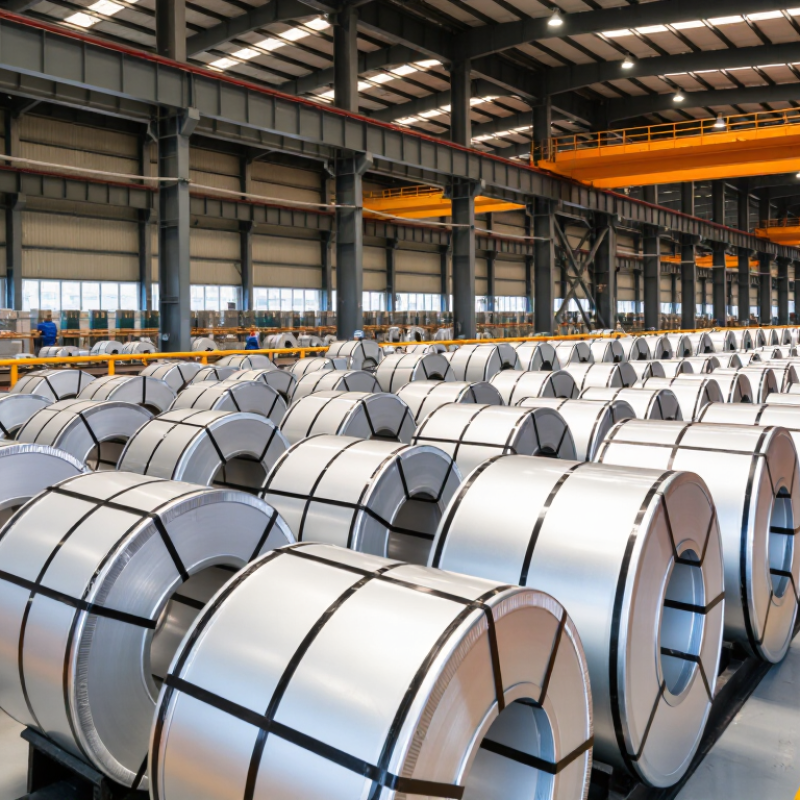
What Makes a Reliable Hot Dip Galvanized Steel Coil Supplier
A reliable Hot Dip Galvanized Steel Coil supplier proves consistency before discussing price.
The World Steel Association reported 1,892.1 million tonnes of crude steel production in 2023. Scale matters, but traceability matters more. Buyers should request heat numbers, mill test certificates, coating mass results, and dimensional records for every shipment.
Look for coils produced under ASTM A653/A653M or EN 10346 requirements. These standards help verify steel grade, coating designation, yield strength, and surface quality. A dependable supplier should explain whether zinc coating is measured gravimetrically or through calibrated instruments.
Ask for samples, too. Check edge condition, spangle uniformity, coil weight, and oiling by hand and sight. Small details reveal process discipline.
Supply risk also deserves attention. The U.S. Geological Survey estimated global zinc mine production at about 12 million metric tonnes in 2023. Zinc availability can influence coating costs and delivery schedules.
A serious supplier should show inventory visibility, backup mills, packaging procedures, and realistic lead times. Avoid promises that sound perfect. In practice, even strong suppliers occasionally face vessel delays or surface defects. What matters is transparent reporting, corrective action, and documented replacement terms.
A low quotation may still work, but only after freight, inspection, claims, and downtime are calculated.
Key Criteria for Evaluating Galvanized Steel Coil Quality
Choosing among the 10 best hot dip galvanized steel coil suppliers requires more than comparing prices. Start with the coating specification. Confirm the zinc coating mass, grade, steel chemistry, and dimensional tolerances. Reliable suppliers should provide heat numbers, inspection records, and current test certificates. Standards such as ASTM A653 or EN 10346 can make comparisons clearer.
Look closely at the coil surface. A consistent spangle, clean edges, and limited white rust indicate careful processing and storage. Small scratches may appear during handling, but deep gouges can expose the base steel. Check thickness with calibrated equipment, not by appearance alone. Ask how samples are selected and whether tensile, bend, and coating adhesion tests are documented. Paperwork matters.
So does traceability.
A practical review should include packaging and delivery controls. Coils need firm strapping, stable supports, and protection from rain during transport. Moisture trapped between tightly wound layers can create staining before the material reaches production. Supplier quality teams should explain corrective actions, not merely promise perfect results. That promise deserves doubt. Even experienced mills can face uneven coating, measurement errors, or shipping damage. Compare independent inspection reports with the supplier’s records. Visit the facility when order volume justifies the cost. Speak with technical staff, not only sales representatives. Their answers often reveal whether quality control is routine or reactive. Consider previous applications, required forming performance, and the buyer’s actual storage conditions before approving any supplier.
10 Best Hot Dip Galvanized Steel Coil Suppliers - Key Criteria for Evaluating Galvanized Steel Coil Quality
Use the following measurable criteria to compare hot-dip galvanized steel coil suppliers without relying solely on price or marketing claims.
| No. | Evaluation Dimension | Reference Requirement or Benchmark | Evidence to Request from the Supplier | Suggested Weight | Quality Rating Guide |
|---|---|---|---|---|---|
| 1 | Coating Mass | Confirm the specified zinc coating designation. Under EN 10346, common designations include Z100, Z275, Z350, Z450 and Z600, expressed as total coating mass on both surfaces in g/m². | Mill test certificate, coating-mass test results and the applicable product standard. | 20% | Excellent: Results consistently meet or exceed the ordered designation. |
| 2 | Standard Equivalence | For ASTM A653/A653M orders, G90 corresponds to a nominal total coating mass of approximately 0.90 oz/ft², or about 275 g/m², on both surfaces. | A certificate identifying the exact standard, coating designation, test method and edition used. | 10% | Excellent: No unresolved conflicts between buyer specifications and supplier standards. |
| 3 | Base Steel Grade | The steel grade must match the application, such as commercial forming, forming, deep drawing or structural steel grades defined by the applicable standard. | Heat number, chemical composition, yield strength, tensile strength and elongation results. | 15% | Excellent: Mechanical properties remain within the ordered grade range. |
| 4 | Dimensional Accuracy | Thickness, width, coil weight, flatness and edge condition should comply with the tolerances in the agreed product standard and purchase order. | Dimensional inspection report, measured coil map and documented tolerance limits. | 10% | Excellent: Low variation and no recurring out-of-tolerance findings. |
| 5 | Surface Quality | Select the required surface quality and finish, such as regular, minimized or zero spangle, according to the required appearance and forming performance. | Visual inspection standard, sample panels, defect limits and photographs of representative coils. | 8% | Excellent: Uniform appearance with controlled scratches, stains and bare spots. |
| 6 | Coating Adhesion | The zinc layer should remain firmly bonded during the intended forming operation and should not show excessive peeling, flaking or powdering. | Bend or forming-test records performed according to the specified standard and application requirements. | 10% | Excellent: Passes the agreed forming test without unacceptable coating damage. |
| 7 | Corrosion-Protection Fit | Higher zinc coating mass generally provides greater sacrificial protection, but service life also depends on environment, drainage, cut edges, forming and post-treatment. | Recommended coating designation for the service environment and documented application guidance. | 8% | Excellent: Coating selection is justified by exposure conditions, not by price alone. |
| 8 | Traceability | Every coil should be traceable from the purchase order to the production batch, heat number, inspection results and shipping documentation. | Coil ID, heat number, production date, packing list and certificate cross-reference. | 7% | Excellent: Complete records can be retrieved quickly for each coil. |
| 9 | Testing and Inspection Control | Testing should cover coating mass, dimensions, mechanical properties, surface condition and packaging, using recognized methods agreed in advance. | Inspection plan, calibration records, laboratory reports and nonconformance reports. | 7% | Excellent: Results are independently verifiable and equipment is calibrated. |
| 10 | Packaging and Delivery Reliability | Coils require secure strapping, moisture protection, suitable edge protection and clear identification to reduce transit damage and storage corrosion. | Packaging specification, loading photographs, delivery performance history and damage-claim records. | 5% | Excellent: Consistent on-time delivery with minimal transport or storage damage. |
| Total Suggested Evaluation Weight | 100% | Use with project-specific requirements | |||
Profiles of the 10 Best Hot Dip Galvanized Steel Coil Suppliers
The ten suppliers below are profiled by production control, coating consistency, certification, and delivery reliability. Industry data provides useful context: the World Steel Association reported 1.89 billion tonnes of global crude steel production in 2023. Zinc availability also affects galvanized coil costs and lead times.
The integrated East Asian mill offers high-volume coils and automated coating lines. Its strongest feature is stable zinc thickness across wide widths. The European flat-steel producer suits automotive applications, with strict surface-finish inspection. The North American supplier provides ASTM A653-compliant coils and responsive regional delivery.
The Indian export mill combines competitive pricing with large batch capacity. Its documentation, however, should be checked carefully. The Turkish producer serves construction buyers with flexible minimum orders and practical packaging.
The South Korean technology-focused mill emphasizes smooth surfaces for exposed panels. The Chinese coastal supplier offers extensive gauges, but buyers should verify independent test records. The Middle Eastern producer reduces shipping distance for nearby infrastructure projects. The Southeast Asian service center provides slitting, leveling, and faster dispatch. The specialized niche mill handles high-strength grades and demanding forming requirements. These profiles reflect procurement priorities, not an absolute ranking.
The International Zinc Association identifies coating thickness, adhesion, and corrosion resistance as critical performance factors. Buyers should request mill test certificates, coating-mass results, dimensional tolerances, and salt-spray evidence. Warehouse photographs can reveal edge damage and poor wrapping. No supplier is perfect. Even a reliable mill may miss a delivery window during maintenance or port disruption. Supplier audits remain necessary.
Comparing Prices, Production Capacity, and Delivery Services
10 Best Hot Dip Galvanized Steel Coil Suppliers
Comparing prices requires more than reading the quoted price per ton. A reliable buyer checks zinc coating weight, steel grade, coil thickness, width tolerance, and testing fees. A low offer may exclude packaging, inland transport, or port charges. Ask for a complete landed-cost estimate. Request recent mill certificates and sample inspection records. Details matter.
Production capacity affects both price and schedule. Large facilities may offer better rates for repeat orders, but smaller plants can sometimes provide more flexible dimensions. Confirm monthly output, available galvanizing lines, and current order queues. A supplier claiming 50,000 tons monthly should explain its equipment and typical export volume. Capacity figures need evidence. I have seen impressive numbers hide limited availability for custom specifications.
Delivery service should be measured in practical terms. Compare production time, booking time, loading arrangements, and estimated transit days. Ask whether coils are protected with waterproof paper, steel strapping, and suitable edge guards. One damaged coil can erase a small price advantage. Clarify the destination port, shipping terms, documentation, and delay procedures before signing. Do not assume “ready stock” means immediate shipment; some stock still needs testing or repacking. A written timeline is safer than a confident sales promise.
How to Choose the Right Galvanized Steel Coil Supplier
Choosing the right hot dip galvanized steel coil supplier requires more than comparing prices. Examine the supplier’s practical experience with your steel grade, width, thickness, and coating requirement. Ask for recent mill certificates, coating test results, and production records. A reliable supplier should explain zinc bath control, surface treatment, edge quality, and dimensional tolerance in clear language. Vague answers are warning signs.
Request samples before placing a large order. Check the surface under strong light for bare spots, heavy zinc lumps, scratches, and uneven spangle. Confirm whether the coating meets the required ASTM, EN, or ISO specification. Independent testing can verify coating mass, tensile strength, elongation, and bend performance. Also inspect packaging details, including waterproof paper, steel straps, coil weight, and loading photos. Small details matter.
Review delivery history, complaint handling, and communication speed. A supplier that reports delays early is usually safer than one that promises everything. Compare the full landed cost, not only the quoted coil price. Freight, testing, packaging, and storage can change the result. A low quote may hide a thinner coating or inconsistent steel grade. It happens.
Try a factory audit, video inspection, or verified third-party visit. Confirm equipment maintenance and traceability from raw material to shipment. No checklist is perfect. Even experienced buyers can overlook a detail when schedules become tight. Keep written specifications, approval samples, and inspection records before production begins.
Article Source:
Have Questions? We're Here to Help!
Give us a call at (864) 989-0566 or send us a message to discuss our testing equipment with an expert.